English
 Arabic
 French
 Spanish
 Portuguese
 Deutsch
 Turkish
 Dutch
Dutch
 Italiano
 Russian
 Romaian
 Portuguese (Brazil)
 Greek
Greek
Expert Security Guard Services in Noida for Businesses and Homes
Other |
2026-08-17 05:04:42
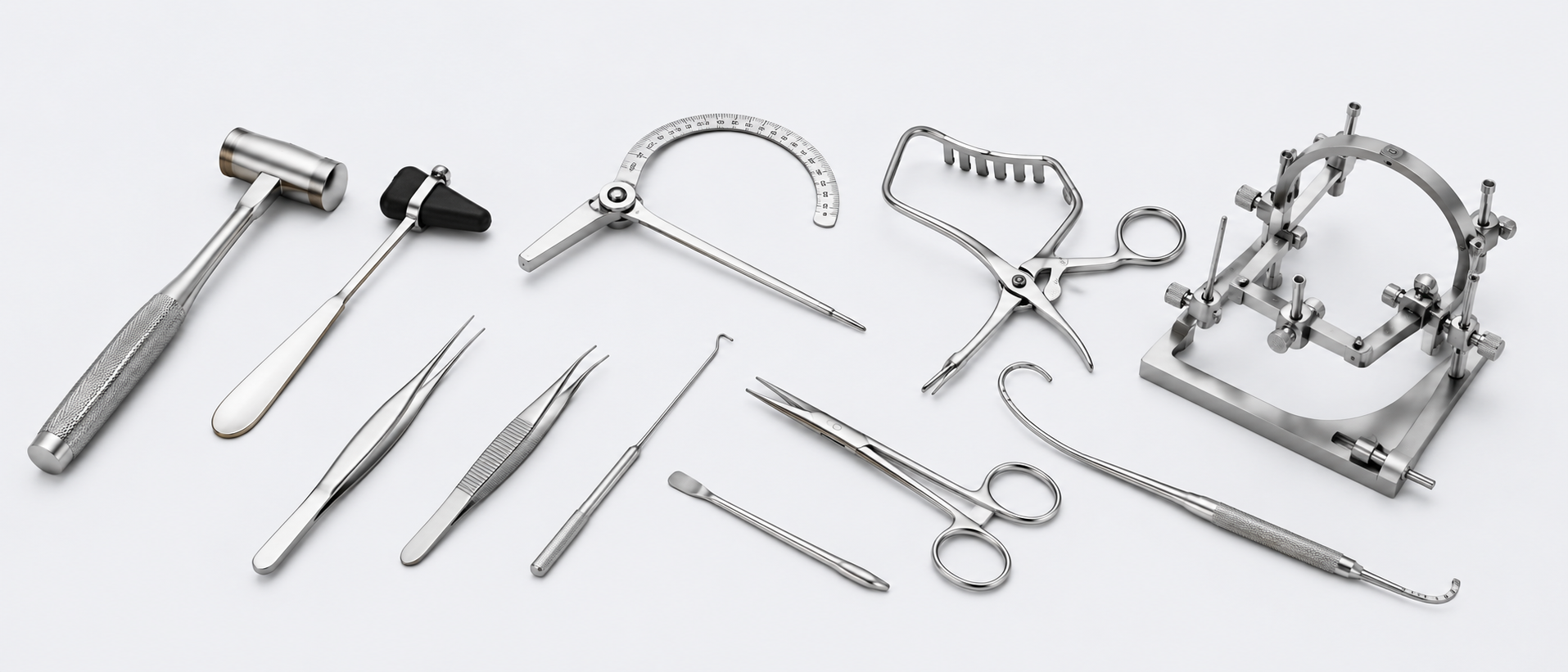
A procurement manager in Nairobi once told us he'd switched suppliers four times in two years, chasing a lower quote each time. Every batch arrived with a different problem — soft forceps tips, mismatched handle grips, a certificate that didn't match the shipment. He came to us after the fourth failure. That's the pattern we see constantly among buyers sourcing neurology instruments for the first time: price wins the RFQ, and quality control loses the contract. Hospitals and distributors who've been burned once don't make that mistake twice. They start asking harder questions about who actually made the neurology equipments on their table — not just who sold them.
This isn't a sales pitch dressed up as an article. It's what 58 years in surgical instrument manufacturing has taught us about what separates a supplier from a partner.
Neurology instrument ranges typically span craniotomy sets, micro-dissectors, bipolar forceps, spinal instruments, and neuro-endoscopy accessories. Each category demands different steel grades, different finishing tolerances, and different sterilization behavior.
Craniotomy and Cranial Sets — perforators, burr hole covers, dura hooks, bone rongeurs
Micro-Neurosurgery Instruments — micro-scissors, micro-forceps, bipolar cautery forceps
Spinal Instruments — laminectomy rongeurs, spinal retractors, disc forceps
Neuro-Endoscopy Instruments — rigid endoscope handling tools, biopsy forceps
Most RFQs specify instrument names and quantities. Almost none specify hardness testing (Rockwell HRC range) or the exact stainless steel grade — usually AISI 410 or 420 for cutting edges, versus 304 for non-cutting components. Skip that line item, and you'll receive instruments that pass a visual inspection and fail after 40 autoclave cycles. We've had buyers call back at cycle 35, asking why the tips have gone soft. The answer is almost always in the steel grade nobody asked about.
1. Documented ISO Certification, Not a Claim of It A bad answer: "We're certified, I'll email you the copy later." A supplier who can't produce a current ISO 13485 certificate on the call isn't hiding paperwork — they're hiding a lapsed one.
2. Traceable Raw Material Sourcing A bad answer: "Our steel is imported, top quality." Top quality from where? Which mill, which grade, which batch certificate? Vague sourcing claims are the first sign of inconsistent output.
3. In-House Manufacturing Capability A bad answer: "We coordinate with our production partners." That means the supplier is a trading house wearing a manufacturer's label, and quality control sits with someone you'll never speak to.
4. Defect and Replacement Policy in Writing A bad answer: "We'll handle defects case by case." That's not a policy. That's a negotiation you'll lose after the shipment has already landed and the buyer has moved on to the next order.
5. Export Track Record with Verifiable References A bad answer: "We ship worldwide" with no country names offered. Ask which markets, ask for a reference buyer, and see how quickly the confidence drops.
Buyers don't need another list of adjectives about quality. They need reasons tied to money and risk.
Fewer Rejected Batches at Customs and Hospital Inspection. Instruments manufactured to consistent hardness and finish specs clear quality checks the first time, which protects your delivery timelines.
Lower Total Cost Per Instrument Over Its Service Life. A cheaper instrument that fails after 20 sterilization cycles costs more than a well-made one that survives 200.
Protected Margins on Resale. Distributors reselling inconsistent stock absorb the cost of complaints and replacements — that eats directly into margin, order after order.
Fewer Compliance Headaches. Working with an ISO-certified, since-1967 manufacturing base means documentation is already in order when your end buyer's procurement team asks for it.
Predictable Reorder Cycles. When batch quality doesn't fluctuate, you stop over-ordering as a buffer against defects. That alone frees up working capital.
Direct Factory Communication. No layers of middlemen diluting your specification requests or slowing down revisions.
We manufacture and ship from 1382/1046, Raja Garden, Basti Danishmandan, Near Vishal Tools, Jalandhar – 144002, Punjab, India. Jalandhar isn't a random location. It's one of India's oldest surgical instrument manufacturing clusters, with a skilled labor base, established forging and grinding infrastructure, and proximity to Delhi's air cargo terminals for faster export dispatch.
That local ecosystem matters more than most first-time buyers realize. A single instrument passes through forging, hand-filing, grinding, polishing, and inspection — often across specialized workshops within a few kilometers of each other. Manufacturers based in this cluster, like us, tap into decades of accumulated craft skill that isn't easily replicated elsewhere. As a result, we work with neurology instruments dealers, neurology instruments wholesalers, and hospital procurement teams across India, the Middle East, Europe, and Africa, shipping from this Jalandhar facility.
We've been manufacturing surgical instruments since 1967. That's not a marketing line — it's three generations of the same family learning, the hard way, what actually holds up in an operating theatre. We're ISO-certified, and we treat that certification as an operating standard, not a wall plaque.
Here's something only a real manufacturer would tell you: we stopped sourcing a particular batch of imported forceps blanks in 2019 after two consecutive shipments showed inconsistent tip alignment under magnification. We switched suppliers mid-contract and absorbed the cost ourselves rather than pass defective stock downstream. That's the kind of decision that doesn't show up in a brochure, but it's exactly what 58 years of export relationships is built on. Buyers don't remember the year we got a certificate. They remember the year we didn't ship them a bad batch.
Email us your instrument list with quantities, or send us your existing spec sheet if you're switching suppliers and want a direct comparison. We respond to serious inquiries within 24 to 48 business hours. Our standard MOQ starts at 50 pieces per instrument code for most neurology sets, though this varies by item — ask us directly if you're testing a new line before committing to volume. Include your target country, since sterilization packaging and documentation requirements differ by region.
Experience isn't a tagline in this industry — it's the difference between a supplier who catches a steel-grade issue before it ships and one who lets you find it in an operating theatre. Hospitals and distributors choosing neurology instruments manufacturers with a long export history aren't being sentimental. They're reducing risk in a category where a defective instrument isn't a returned parcel — it's a surgery delayed. That calculation gets easier every year a manufacturer stays in business and keeps its shipments clean.
Neurology instruments demand tighter tolerances — micro-forceps and dissectors are often under 2mm at the working tip, and any inconsistency in grinding shows up immediately under a surgical microscope. General surgical tools have more margin for minor variance.
We manufacture in-house at our Jalandhar facility. We're not repackaging stock from unnamed third-party workshops, which is common among suppliers who call themselves manufacturers but outsource production.
Both. A significant part of our neurology instruments orders are from neurology instruments dealers and neurology instruments wholesalers who sell on regional hospital networks, apart of course direct toinstitutional buyers.
Our standard purchasing quantity is 50 pieces per code but we‘ll be honest, for completely new specs or custom instruments, we occasionally require a higher amount to justify tooling costs. It depends on the product so ask rather than make assumptions.
Yes, batch-wise material test certificates and ISO 13485 certification documentation comes as a part and parcel of every export consignment.
Most standard neurology sets are 3 to 5 weeks long, depending on the size of the order, and the complexity of the instrument. Custom or first iteration specifications will take longer, as tooling and sample approval will need to be completed upfront.
Yes, we provide private labeling for wholesale/distribution partners but we will be honest about it labels and packaging changes generally add an extra 5-7 days to normal production speeds.