English
 Arabic
 French
 Spanish
 Portuguese
 Deutsch
 Turkish
 Dutch
Dutch
 Italiano
 Russian
 Romaian
 Portuguese (Brazil)
 Greek
Greek
South Korea Whiskey Market Size, Share, Industry Overview, Trends and Forecast 2025-2033
Other |
2025-12-11 10:39:13
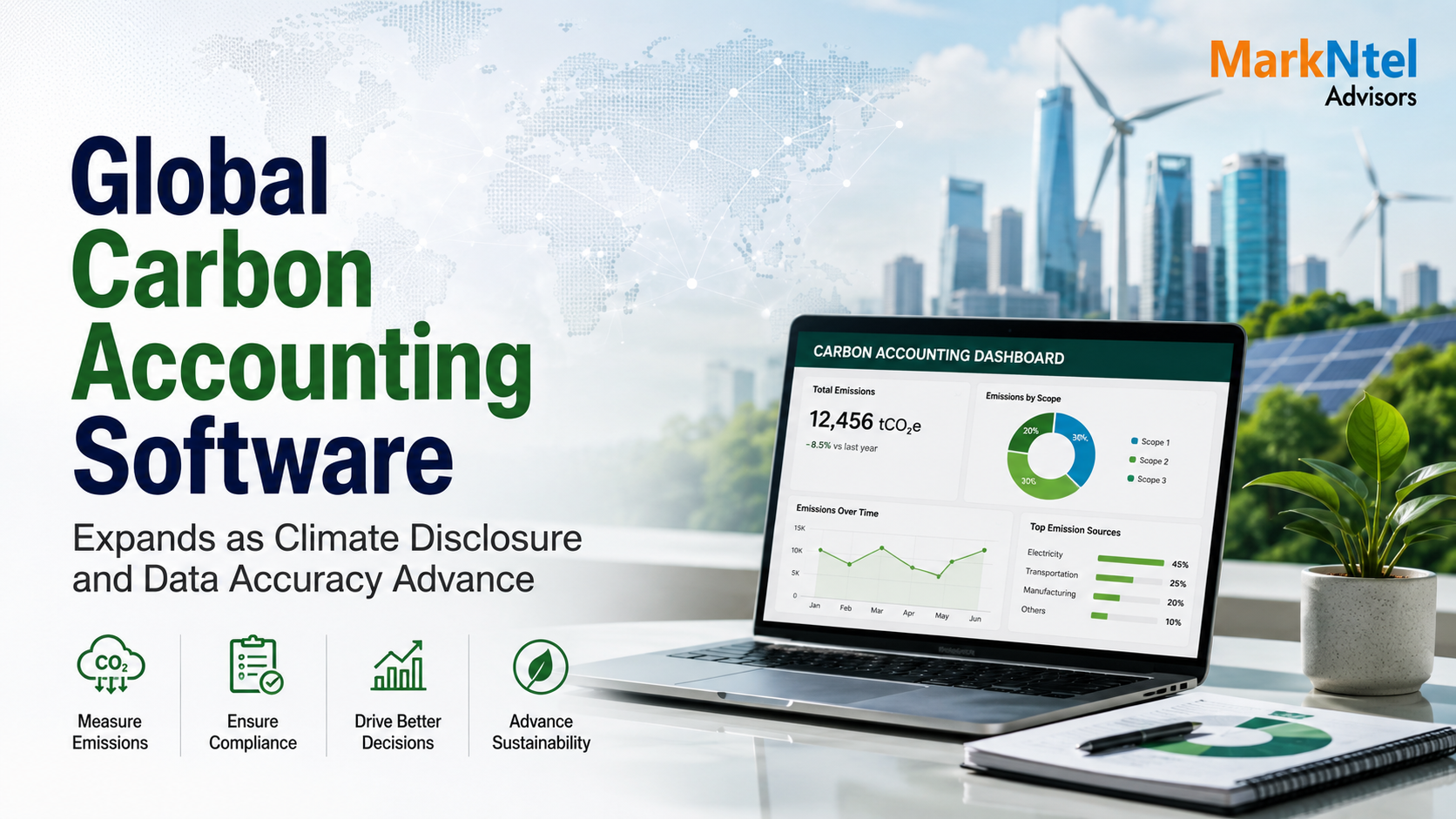
Companies across sectors are facing growing requirements to measure greenhouse-gas emissions, organize environmental data, and communicate climate-related information. As sustainability reporting becomes more structured, organizations are moving beyond manual spreadsheets toward digital systems that can collect, manage, validate, and analyze emissions information across business operations and supply chains.
A recent study by MarkNtel Advisors states that the Global Carbon Accounting Software sector was valued at USD 19.34 billion in 2025 and is projected to reach USD 96.06 billion by 2032, registering a CAGR of 25.73% during 2026–2032. The market's development is supported by regulatory requirements, rising climate disclosure expectations, increasing data complexity, AI and automation, and demand for structured emissions-management systems.
Climate-related reporting is becoming more structured across major economies, requiring organizations to maintain reliable information about environmental risks and impacts. In Europe, sustainability reporting requirements are governed through the Corporate Sustainability Reporting Directive and European Sustainability Reporting Standards.
The European Commission states that companies within the applicable scope must disclose information on sustainability-related risks, opportunities, and impacts. Its corporate sustainability reporting framework outlines the regulatory structure and reporting requirements.
These requirements can increase demand for software capable of organizing emissions data and supporting consistent reporting processes.
Carbon accounting generally involves measuring emissions across different operational and value-chain sources. The GHG Protocol categorizes corporate emissions into Scope 1, Scope 2, and Scope 3, covering direct emissions and indirect emissions associated with purchased energy and other activities.
The GHG Protocol Corporate Standard provides definitions for these emission categories and supports organizations in developing corporate greenhouse-gas inventories.
Carbon accounting platforms can help organizations organize these datasets within structured systems rather than managing information through disconnected files and manual calculations.
Large enterprises accounted for around 82% of the Global Carbon Accounting Software Market in 2025. Their leading position is linked to complex operating structures, extensive supply chains, multiple reporting jurisdictions, and larger volumes of emissions-related information.
Large organizations may need to collect data from facilities, procurement systems, transportation networks, energy consumption records, suppliers, and other operational sources. Software can provide a centralized environment for managing this information and preparing standardized calculations.
The need for traceable and organized data can become particularly important when sustainability information is subject to external review.
The energy and utilities sector held around 32% of the market in 2025. The sector's significant emissions footprint and extensive operational infrastructure create substantial requirements for emissions measurement and monitoring.
Energy companies can need to track emissions across generation assets, fuel consumption, transmission infrastructure, distribution activities, and other operational processes. Digital accounting systems can help consolidate information from multiple sources and support reporting across different organizational units.
The sector's broader transition toward lower-carbon energy systems also increases the importance of reliable emissions data for evaluating progress.
Artificial intelligence and automation are becoming important features within carbon accounting platforms. Organizations often manage emissions information from numerous operational systems, creating challenges around data collection, classification, validation, and calculation.
Automated systems can connect with enterprise resource planning platforms, utility records, procurement databases, logistics systems, and other data sources. AI-based tools can assist with categorizing activity data, mapping emissions factors, identifying anomalies, and reducing repetitive manual work.
These capabilities can help organizations handle larger datasets while improving consistency across reporting workflows.
Reliable carbon accounting depends on the quality of underlying activity data. Organizations may encounter incomplete supplier information, inconsistent measurement methods, different emissions factors, and fragmented internal systems.
Scope 3 accounting can be particularly challenging because relevant emissions occur across value chains outside a company's direct operational control. Supplier information may not always be available at the required level of detail, creating difficulties in building comprehensive inventories.
Interoperability between enterprise systems and carbon accounting platforms is therefore becoming increasingly important.
Cloud-based software can provide organizations with centralized access to emissions information while supporting integration across geographically distributed operations. This can be useful for enterprises that operate multiple facilities, business units, and supply-chain networks.
Cloud deployment can also facilitate software updates, centralized data management, user collaboration, and integration with other digital systems. However, organizations must consider cybersecurity, access controls, data governance, and third-party technology risks when implementing cloud-based sustainability systems.
Carbon accounting software is not limited to reporting functions. Structured emissions data can also support internal decision-making by helping organizations identify high-emission activities, compare operational performance, and evaluate potential reduction measures.
Companies can use organized emissions information to understand the relationship between operational activity and carbon output. This can support more informed planning around energy use, procurement, logistics, production, and other emissions-intensive activities.
Effective carbon accounting increasingly depends on connections with existing enterprise systems. ERP platforms, procurement software, utility databases, travel systems, logistics applications, and supplier-management tools can contain information relevant to emissions calculations.
Integration can reduce duplicate data entry and create more consistent reporting workflows. It can also help organizations maintain a clearer audit trail by linking emissions calculations with underlying activity data.
North America accounted for around 45% of the Global Carbon Accounting Software Market in 2025. The region's position is supported by regulatory activity, corporate sustainability programs, digital infrastructure, and the presence of carbon-management technology providers.
Organizations operating in the region are increasingly evaluating automated systems for emissions measurement, disclosure preparation, and climate-related data management. Regulatory developments at state and national levels can further influence demand for structured carbon information.
The Global Carbon Accounting Software Market is developing through regulatory reporting requirements, increasing emissions-data complexity, AI and automation, enterprise software integration, and growing attention to climate governance. The projected increase from USD 19.34 billion in 2025 to USD 96.06 billion by 2032 reflects continued expansion across enterprise and industry applications.
Future development will remain connected with automated data collection, Scope 3 measurement, cloud platforms, AI-enabled analytics, system integration, data quality, and increasingly structured sustainability reporting. As organizations require more consistent and traceable emissions information, digital carbon accounting systems are expected to become increasingly integrated into corporate reporting and environmental data-management processes.