The restaurant industry is brutal. Concepts that open with fanfare close within months. Chains that expand aggressively contract just as quickly. Trends that dominate one year vanish the next. Yet in this landscape of constant churn, some establishments achieve something remarkable: endurance. They survive not through marketing campaigns or celebrity endorsements but through something deeper—a connection to community, a commitment to quality, and a recipe that never needed improvement. For over 74 years, Brown's Chicken has been one of these survivors. From a single trailer at 80th and Harlem in Bridgeview to over 21 locations across Chicagoland, this family-founded institution has outlasted competitors, weathered tragedy, and continued serving the same buttermilk-cottonseed oil recipe that John and Belva Brown perfected in 1949 . The pursuit of the best fried chicken in chicago has always led back to the question of why some things endure.
The Unchanged Recipe
The first reason for survival is the simplest: the recipe has never changed. In an industry where menus rotate quarterly and "limited time offers" dominate marketing, Brown's has done something radical: nothing. The menu states it plainly: "We've added and subtracted many products over the years, but our chicken recipe remains the same and our customers wouldn't have it any other way."
This continuity means that customers who return after decades away find the taste exactly as they remember. A grandmother who first ate Brown's in the 1950s tastes the same buttermilk tang as her grandchild discovering it today. The consistency builds trust that no amount of advertising can manufacture.
The Fresh Chicken Commitment
From the beginning, John and Belva Brown insisted on fresh chicken, never frozen. The menu still states: "We Take Our Chicken Fresh From The Market; Its Never Frozen." This commitment has never wavered. Fresh chicken retains moisture that frozen alternatives lose. The buttermilk batter adheres more effectively to fresh surfaces. The hand-breading process, applied to each piece individually, creates coating that machines cannot replicate.
In an industry where frozen chicken became standard for cost and convenience, Brown's refused to follow. That refusal has cost more but paid back in quality that customers recognize.
The Hand-Breading Tradition
The second reason for survival is visible in every piece. Machine-breaded chicken appears uniform—identical coating thickness, identical pattern, identical appearance across thousands of pieces. Brown's chicken varies slightly from piece to piece because each receives individual attention. The two-stage breading process—flour, buttermilk, flour—creates mechanical interlocking that machines cannot achieve.
This hand-breading is not nostalgia. It is functional. A leg requires different coating thickness than a wing. A larger white meat cut needs different handling than a thigh. Hands can adjust where machines apply uniform treatment.
The Buttermilk-Cottonseed System
The third reason is the ingredients themselves. Real cultured buttermilk containing active lactic acid creates molecular adhesion and adds subtle tanginess that artificial formulations cannot replicate. Cottonseed oil, selected in 1949 for its clean flavor and high smoke point, remains in use today. The combination delivers chicken that is crispy without being greasy, flavorful without being overwhelming.
When health concerns regarding trans fats emerged decades later, Brown's oil was already trans-fat-free. The company did not need to reformulate. It simply continued doing what it had always done.
The Community Connection
The fourth reason for survival is the relationship with community. The Glen Ellyn location, opened in June 1965, became a gathering place where "Families gathered after Little League games. Neighbors picked up take-out on Saturdays. Teenagers came in after school." The owner's son, who grew up behind the counter, later wrote: "Brown's wasn't just a meal—it was a memory. A moment. A tradition."
This connection cannot be manufactured. It grows through decades of presence, through being there for celebrations and ordinary Tuesdays alike. When a restaurant becomes woven into the fabric of community life, customers will return even when times are hard.
The 1993 Test
On January 8, 1993, the Brown's Chicken massacre at the Palatine location tested survival as few events ever test a brand. Seven people were murdered—owners Richard and Lynn Ehlenfeldt and five employees. Sales dropped 35 percent systemwide, and the company eventually closed 100 locations.
Yet the survivors endured. Over 21 locations remain in operation today. The recipe that emerged from that Bridgeview trailer continued emerging from fryers, unchanged. The fresh chicken, the hand-breading, the buttermilk batter, the cottonseed oil—all continued. Customers returned because the connection was deeper than any single location.
Chicken Pieces: The Foundation
The bone-in chicken pieces that form Brown's foundation have anchored this survival. The 12-piece assortment—three legs, three thighs, three wings, and three larger white meat cuts—delivers the balanced variety that families expect . When a family orders the 12-piece, they are participating in a tradition that has spanned generations.
Wings: The Adaptable Classic
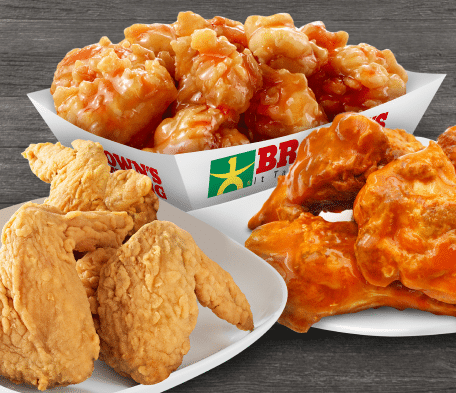
Brown's Jumbo Buffalo Wings demonstrate how the brand has adapted while preserving its core. Described as "mighty meaty and mighty good," these wings satisfy contemporary preferences for shareable, flavorful formats . Available traditional Buffalo-style, extra hot, or with zesty BBQ sauce, they accommodate varied tastes without compromising the foundation.
Tenders: The Gateway for New Generations
Jumbo tenders, cut from whole all-white meat, have become the entry point for younger diners. The approximately dozen dipping sauces available allow children to customize their experience while discovering the same buttermilk-cottonseed flavor that has defined Brown's for decades . These children become the adults who will return with their own children.
Sandwich: The Dare That Endures
The Original Jumbo Chicken Sandwich carries a menu dare that has survived as long as the brand: "we dare to say ours tastes better!" . The whole premium filet, batter-dipped and fried, served on a fresh-baked roll with lettuce and mayo, represents the confidence that comes from 74 years of consistency.
Bowls: Survival Through Adaptation
Brown's Bowl collection represents how the brand has survived by adapting to contemporary eating patterns. The Homestyle Chicken Bowl layers boneless chunks over mashed potatoes with gravy and corn. The Buffalo Mac & Cheese combines Buffalo-sauced chicken with creamy macaroni . These compositions keep the brand relevant for new generations.
Express Catering: Survival at Scale
Brown's Express Catering operation has become the area's largest, serving businesses and home events from 20 to 2,000 guests . This capability ensures that Brown's is present for life's biggest moments—weddings, reunions, celebrations—not just everyday meals.
The Professional Detailing Parallel
The survival of Brown's across 74 years parallels the endurance of professional car detailing services that have served families for generations. A detailer who maintains consistent quality across decades earns a reputation that no marketing can manufacture. The same hand techniques, the same quality products, the same attention to detail—applied consistently across every vehicle.
Mobile car detailing services extend this survival to client locations, proving that quality need not require inconvenience . The detailer who arrives at a driveway carries not only equipment but a reputation built through consistent results. Brown's operates on identical principles: survival through consistency, not through flash.
The Joliet Return
The January 2026 reopening of Brown's Chicken at 410 South Chicago Street in Joliet demonstrates why survival matters . Brown's had previously operated on Jefferson Street and South Larkin Avenue. Their closure left a void that the new location now fills. Customers who remembered previous locations returned with their children and grandchildren. Survival means being there when communities need you.
The Mushrooms That Survived
No account of Brown's survival would be complete without acknowledging the mushrooms. The menu admits: "our mushrooms are as legendary as browns chicken itself." Hand-breaded and fried to golden perfection, they have survived alongside the chicken, developing their own devoted following.
Conclusion
Why has Brown's Chicken survived for over seven decades? The answer lies in choices made in 1949 and honored ever since. Fresh chicken, never frozen. Hand-breading, each piece individually. Buttermilk batter, real cultured buttermilk. Cottonseed oil, selected for its clean flavor. And the refusal to change what works. Through expansion and contraction, through tragedy and return, through changing tastes and competitive pressure, these choices have held. The pursuit of the best fried chicken in chicago has always led back to a family recipe that did not need improvement. That is why Brown's survives. That is why it will continue.
Frequently Asked Questions
How has Brown's Chicken survived for over 70 years?
Through an unchanged 1949 recipe, fresh never-frozen chicken, hand-breading, buttermilk batter, cottonseed oil, and deep community connections that have weathered tragedy and change .
Has the chicken recipe changed since 1949?
No. The buttermilk batter, cottonseed oil, and hand-breading process remain completely unchanged from John and Belva Brown's original recipe .
What happened to Brown's in 1993?
On January 8, 1993, seven people were murdered at the Palatine location. Sales dropped 35% and 100 locations closed, yet the survivors endured with over 21 locations still operating .
What is the Glen Ellyn story?
The Glen Ellyn location opened in 1965 and became a family business where the owner's son grew up in the restaurant, later writing about families gathering after Little League .
Does Brown's use fresh or frozen chicken?
Brown's explicitly states that chicken is taken fresh from the market and never frozen, a commitment maintained since 1949 .
What makes Brown's chicken different from competitors?
The combination of fresh chicken, hand-breading, real cultured buttermilk batter, and cholesterol-free cottonseed oil creates quality that competitors have compromised .
How many Brown's locations exist today?
As of 2024, Brown's operates over 21 restaurants, all within the Chicago metropolitan area .
What is the Joliet location's significance?
Brown's reopened in Joliet at 410 South Chicago Street in January 2026, restoring a community favorite after previous locations closed .
Are the mushrooms as good as the chicken?
The menu describes them as "as legendary as browns chicken itself," and customer reviews consistently confirm this reputation .
Does Brown's offer catering for events?
Yes. Brown's Express Catering serves gatherings from 20 to 2,000 guests with party packs, family meals, and custom configurations .
 English
 Arabic
 French
 Spanish
 Portuguese
 Deutsch
 Turkish
 Dutch
Dutch
 Italiano
 Russian
 Romaian
 Portuguese (Brazil)
 Greek
Greek