English
 Arabic
 French
 Spanish
 Portuguese
 Deutsch
 Turkish
 Dutch
Dutch
 Italiano
 Russian
 Romaian
 Portuguese (Brazil)
 Greek
Greek
Cnt Dispersant Market Size, Share, Growth Analysis Report [2035]
Other |
2026-03-26 11:32:35
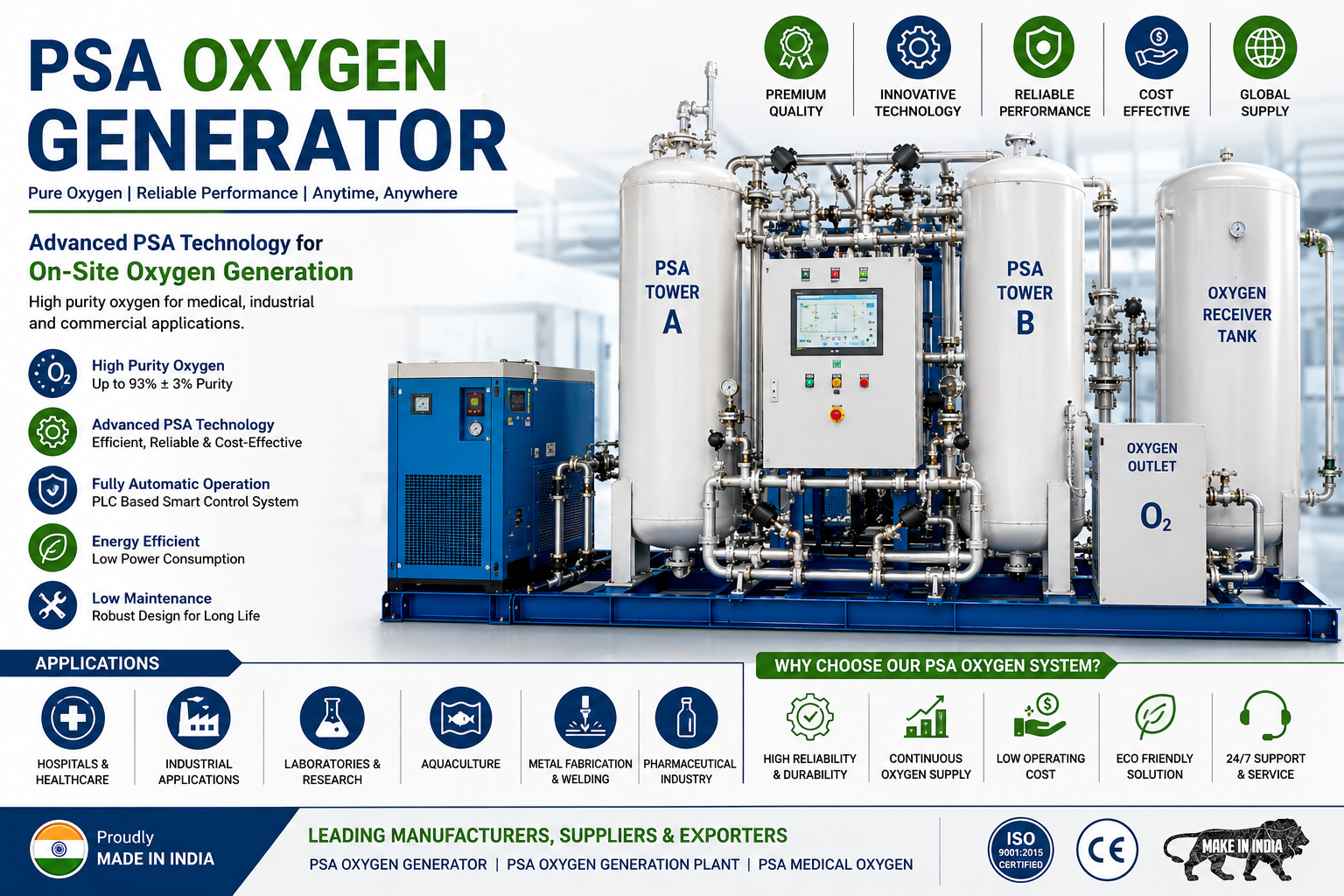
Half the trouble begins before the purchase order is even signed. A hospital, distributor, or project buyer asks for a PSA Oxygen Generator, gets three quotations, compares only the price, and assumes all systems doing 93% oxygen are the same.
They are not.
For medical and industrial buyers, the real decision is not only about buying a machine. It is about stable oxygen output, verified purity, clean compressed air, site readiness, installation support, operator training, and service response after commissioning. WHO technical guidance recognises PSA plants for producing medical oxygen at 93%±3 from ambient air, which makes specification control more than a formality. It becomes the difference between a working oxygen supply and a repeated complaint cycle.
Nobody tells you this early enough: most PSA failures are not dramatic. They show up as purity fluctuation, moisture carryover, valve issues, weak filtration, delayed spares, or poor site planning.
That is why choosing the right PSA Oxygen Generator Manufacturers in India needs a procurement lens, not a brochure-reading habit.
The common headline figure is 93%±3 oxygen purity. That range matters because PSA technology works by separating oxygen from ambient air through compressed air treatment and molecular sieve adsorption. But a buyer who only asks, “What is the purity?” is asking half a question.
Here’s the better list: purity range, flow rate, output pressure, compressor compatibility, dryer type, filtration stage, storage tank requirement, PLC control, alarms, power load, ambient temperature tolerance, and service access around the plant.
One overlooked specification is dew point.
If the air dryer selection is weak, moisture can travel into the system and shorten molecular sieve life. That problem does not always appear during the first demo. It appears after the plant has run under actual site conditions for weeks, sometimes with dust, heat, voltage fluctuation, and irregular maintenance.
A PSA Oxygen Generation Plant should be sized against actual oxygen consumption. For hospitals, that may include ICU beds, emergency wards, OT demand, pipeline losses, and backup cylinder filling needs. For industrial users, it may include process demand, shift duration, pressure needs, and buffer storage.
Buying undersized equipment is bad procurement.
Oversizing is not automatically smart either. A bigger system may need more floor space, more power, larger compressors, stronger ventilation, higher initial cost, and different freight planning. Which means the right plant is the one matched to verified demand, not the one that looks safer on paper.
Most buyers discuss machinery. Fewer discuss the room where the machinery will sit.
A PSA setup needs stable electrical supply, ventilation, foundation readiness, compressor placement, drainage consideration, pipeline access, and safe maintenance space. If the buyer confirms the order without site dimensions, power availability, and installation route, the lead time can slip even when the machine is ready.
Most delays do not start on the production floor. They start when basic site data remains unclear until installation week.
A good supplier should explain how purity, pressure, air quality, and control functions are checked before dispatch. A weak answer sounds like, “Sir, plant is standard.”
That is not enough.
Ask whether QC inspection includes oxygen purity reading, leak checks, compressor compatibility review, electrical panel checks, alarm testing, and packing inspection. For a medical oxygen project, specification compliance should be recorded before dispatch and again during commissioning.
For many buyers, MOQ is not only about quantity. It affects cash flow, storage, project approval, and internal budgeting. Some suppliers push large configurations before studying actual demand.
A practical PSA Oxygen Generator Suppliers discussion should include minimum viable configuration, future expansion possibility, spare parts planning, and whether the buyer needs one system, multiple units, or a plant with cylinder filling support.
Bad supplier behavior is easy to spot here. If every capacity has the same delivery timeline, the answer is probably lazy.
Lead time depends on plant capacity, component availability, control panel readiness, compressor selection, testing schedule, documentation, packing, transport distance, and installation slot. For export orders, freight booking and document preparation add another layer.
Certificate validity should be checked before advance payment. Shelves Tech’s certification page lists Udyam Registration Certificate, Import Export Certificate, and Quality Management Certificate. For medical projects, buyers should also ask what certificates apply to the specific model, not only the company profile.
A supplier who sends unclear certificate copies after dispatch has already moved the risk onto the buyer.
Ask this directly: “If purity drops after commissioning, who checks the plant, within what response time, and what data do you need from our operator?”
A bad answer is, “We will see later.”
That means there is no process. Only a promise.
A well-selected PSA system reduces dependence on repeated cylinder deliveries. For hospitals and healthcare projects, that can protect operations when demand rises suddenly or transport becomes unreliable.
The risk reduction is simple: oxygen is generated on-site instead of waiting for every refill.
Wholesalers and brand owners do not lose money only on the equipment price. They lose margin on rework, delayed commissioning, warranty travel, rejected documentation, and customer complaints.
Choosing reliable PSA Oxygen Generation Plant Manufacturers protects margin because fewer unresolved issues come back through the sales channel.
A system with proper alarms, operator training, and documented QC points is easier to manage. Plant teams can track purity, pressure, maintenance intervals, filter replacement needs, and basic fault signals.
That reduces panic buying.
When plant layout, power requirement, inlet air treatment, and dispatch packing are discussed early, installation becomes less messy. The buyer knows what to prepare. The supplier knows what to send. The technician does not arrive at a site where the electrical point is missing or the room is too tight for maintenance access.
A specification mismatch is rarely discovered during quote comparison. It shows up when the delivered system does not match actual flow, pressure, site voltage, medical use expectations, or documentation needs.
Clear technical approval before production protects the buyer’s purchase order.
For domestic and export shipments, packing is not cosmetic. Panels, valves, gauges, sensors, and fittings need protection from vibration, moisture, and rough handling. Poor packaging can damage a good machine before it reaches the site.
For PSA Oxygen Generator Exporters, this is a serious point. Export packing should be discussed before dispatch, not after a claim is raised.
Shelves Tech operates from Office No -110-111, 1st Floor, Gupta Arcade, Plot no-2, Inder Enclave, LSC Rohtak Road, Paschim Vihar, New Delhi-110087. For Indian buyers, that location is useful because Delhi NCR connects well with transport networks, project buyers, hospitals, distributors, and freight partners.
That matters.
For B2B procurement, location affects inspection visits, document coordination, dispatch planning, spare movement, and response time. A buyer sourcing from PSA Oxygen Generator Manufacturers in India should not look at address as a formality. It affects how quickly the order can move from enquiry to technical discussion, from sampling approval to dispatch, and from delivery to installation support.
For PSA Oxygen Generation Plant Exporters, freight planning must include packing type, port movement, documentation, shipment dimensions, and support for installation guidance after arrival. Export buyers should ask for these points early because one missing document can delay clearance.
We work with hospitals, healthcare facilities, laboratories, and industrial buyers who need oxygen plants, medical equipment, hospital furniture, lab furniture, and surgical consumables from one coordinated source. Our website lists PSA Oxygen Plants as one of our key product categories, along with medical equipment and hospital infrastructure products.
We are ISO-certified since 2013 as per the project brief, and our certification page lists Udyam Registration Certificate, Import Export Certificate, and Quality Management Certificate.
We also know one practical thing from handling healthcare equipment enquiries: buyers often send product names but not operating conditions. That slows everything. For a PSA oxygen project, we need capacity requirement, application, daily operating hours, site location, power availability, pressure requirement, and whether the buyer needs medical oxygen supply, cylinder filling, or industrial process oxygen.
Without that, even a fast quote can become the wrong quote.
We can help you shortlist the right PSA oxygen system, but we need proper input first. Please communicate to us your required capacity, application, site city, your operating hours, required pressure, available power supply, installation timeframe, and expected MOQ or order quantity.
If possible, send us photos or some basic layouts of the installation area. It very likely will help us to expedite our response.
If you are doing a comparison of PSA Medical Oxygen Manufacturers, please send us your expected purity, point of use, pipeline or cylinder filling, and any specific standards or certificates you may require so we can your request for a final quote. Otherwise, we will send a quote to the best of our abilities.
For lead, dispatch, and other restrictions, please send us your order and destination, and we will provide the necessary information.
A PSA Oxygen Generator is not a product to buy only by comparing price rows. The right supplier should explain purity, pressure, air treatment, QC inspection, packing, lead time, and service response with clarity. For Indian and export buyers, these details protect both operations and margin. As oxygen demand keeps growing across healthcare and industrial use, better specification discipline will decide which projects run smoothly after commissioning.
Make sure to look at the oxygen purity and flow rate as well as the output pressure. Consider the compatibility of the Compressor and the quality of the Air Dryer and the PLC controls, and alarms. How responsive the service is, the validity of the certificates, and support for the installation also need to be considered. Price is important. However, low quotes without specifications can result in more costs after commissioning.
Yes, the MOQ can influence the price, as well as how the order is dispatched, and the planned configuration. However, the MOQ should not buy a larger plant than what is actually needed. Provide the supplier with the planned usage to give them the information needed to provide an appropriate configuration.
Most likely, the PSA oxygen systems produce oxygen at 93%±3. The range is acceptable for systems that produce medical oxygen and is based on PSA. However, the systems also need to be designed to provide a proper air supply, and a proper level of filtration along with maintenance and monitoring of the purity.
Most Suppliers provide installation support across India, but customers should validate the offer. Include questions of support for installation, training for the system operators, and completion of commissioning with travel cost and support after the system is installed.
For foreign buyers, packing standards, the size of the shipment, the documentation, copies of certificates, spare parts, and support for on site installation along with the voltage are all expected. A constraint is that most support is offered remotely and cannot substitute adequate preparation on site, therefore, the buyer's team should be prepared to receive the shipment prior to the arrival of the plant.
They may be used, given that the system is designed for medical oxygen and the appropriate documentation is provided. Not all oxygen generators are hospital-compatible. There are other factors for Medical oxygen that require more rigorous management, e.g. alarm thresholds, pipeline and component compatibility, system and pipeline integrity, etc.
It is imperative that differences in specifications, lead times, service, and packing/certification be understood. The trade-off is, that the buyer runs the risk of confusion due to an excess of quotations, if he has not previously defined the technical scope. Clearly define the technical scope, then compare.