English
 Arabic
 French
 Spanish
 Portuguese
 Deutsch
 Turkish
 Dutch
Dutch
 Italiano
 Russian
 Romaian
 Portuguese (Brazil)
 Greek
Greek
Regional Opportunities in the Non Basmati Rice Market
Other |
2026-07-17 07:26:51
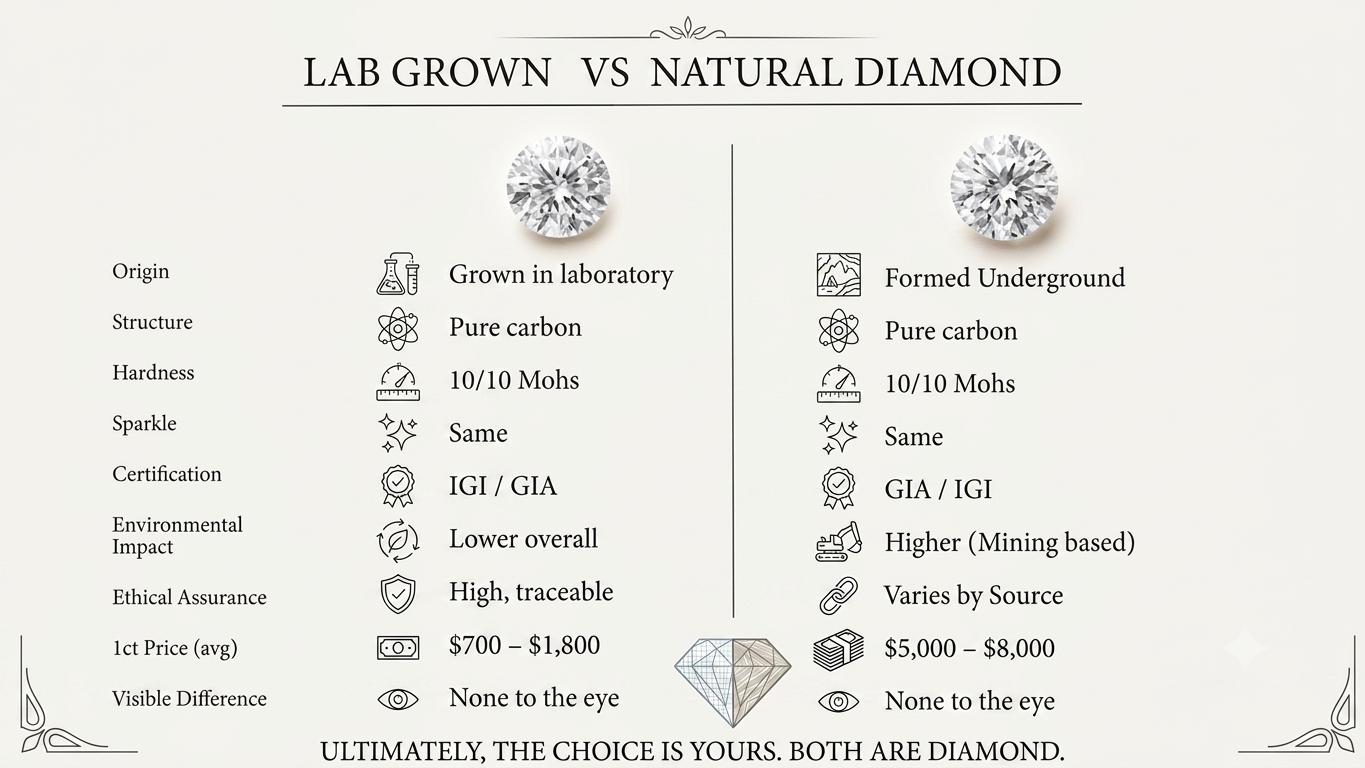
The diamond market has changed more in the past five years than in the previous fifty. Lab-grown stones, once a niche curiosity, now account for a substantial share of diamond jewelry sales and have forced a reckoning over what a diamond is actually worth. By 2026, the conversation is no longer about whether lab-grown diamonds are "real" — they are, chemically and optically — but about where genuine, lasting value sits.
That distinction matters because the two products have diverged sharply in price while remaining nearly identical to the eye. Understanding why requires separating physical sameness from market behavior, and that is where most buyers get confused.
A natural diamond forms over billions of years under intense heat and pressure deep in the earth. A lab-grown diamond is produced in weeks using one of two processes that replicate those conditions in a controlled setting.
The result is the same material. Both are pure crystallized carbon with identical hardness, brilliance, and optical properties. A standard jeweler's loupe cannot tell them apart; distinguishing them reliably requires specialized equipment.
The takeaway is that the difference between the two is one of origin and supply, not quality. That single fact drives everything that follows in the market.
The defining story of the 2026 diamond market is price. As production capacity scaled, the cost of growing diamonds fell steeply, and retail prices followed. Stones that once carried a modest discount to natural now sell for a fraction of the comparable natural price.
The economics are straightforward. Lab-grown supply is effectively unlimited and getting cheaper to produce, which pushes prices toward the cost of manufacturing. Natural supply is finite and cannot be expanded, which sets a different price floor entirely.
This divergence has a direct consequence buyers often overlook: a lab-grown diamond purchased today is likely to be cheaper to produce tomorrow, which undermines any expectation of resale value.
Value in diamonds splits along two very different lines in 2026, and conflating them is the most common mistake buyers make.
For buyers who want maximum size and sparkle for the budget, lab-grown wins decisively. A larger, higher-clarity stone is attainable at a fraction of the natural cost. For engagement rings, fashion pieces, and loose diamonds bought primarily to be worn and enjoyed, this is a rational choice.
For buyers thinking about resale, inheritance, or appreciation, natural diamonds remain the only side of the equation with a credible case. Their finite supply supports a resale market that lab-grown stones lack. A natural stone with strong grades, certification, and ideally documented origin behaves like a scarce asset; a lab-grown stone behaves like a manufactured good.
Neither answer is universally correct. The right choice depends entirely on what the buyer wants the diamond to do.
Resale exposes the gap more honestly than any showroom comparison.
The practical lesson is that no diamond bought at retail should be treated as a guaranteed investment, but the floor under a natural stone is structurally different from the one under a lab-grown stone.
Regardless of origin, certification from a respected laboratory remains essential. A grading report verifies cut, color, clarity, and carat, and it explicitly states whether a stone is natural or lab-grown.
This transparency is non-negotiable in 2026. Reputable laboratories now clearly distinguish lab-grown stones on their reports, and any diamond — natural or grown — should carry documentation before purchase. Established jewelers such as Noble Jewelers Aruba treat certification as a baseline of trust rather than an upsell, which is the standard buyers should expect anywhere.
Diamond value is not uniform across shapes. Round brilliants command a premium because of the rough they consume during cutting and their dominant demand. Fancy shapes — including heart shape diamonds, ovals, and pears — often price differently for the same carat weight.
These pricing quirks apply to both lab-grown and natural stones, but they compound differently. In the natural market, a less common shape in a high grade can carry a scarcity premium. In the lab-grown market, where supply responds to demand quickly, those premiums tend to erode faster.
For buyers comparing options, this means a shape preference can shift the value calculation, and it is worth understanding before fixating on carat weight alone.
The decision comes down to intent. A buyer who wants the most visible diamond for the money, with no expectation of resale, has a strong case for lab-grown. A buyer who values scarcity, potential resale, or heirloom worth should weigh natural stones with strong grades and full documentation.
A few principles hold regardless of side:
The clearest way to think about it in 2026 is that lab-grown and natural diamonds are no longer competing products so much as two different categories that happen to look the same.
Are lab-grown diamonds real diamonds?
Yes. Lab-grown diamonds are chemically, physically, and optically identical to natural diamonds. Both are pure crystallized carbon with the same hardness and brilliance. The only difference is origin: one forms in the earth over billions of years, the other in a controlled facility over weeks. Standard visual inspection cannot tell them apart.
Do lab-grown diamonds hold their value?
Generally, no. Because production costs keep falling and supply is effectively unlimited, lab-grown diamonds have minimal resale value. New equivalent stones get cheaper over time, which undercuts secondhand pricing. Buyers should treat lab-grown diamonds as consumer purchases for enjoyment rather than as investments or stores of value.
Why are natural diamonds more expensive in 2026?
Natural diamonds have a finite, non-renewable supply, which supports higher prices and a resale market. Lab-grown supply can expand to meet demand, pushing prices toward production cost. As lab-grown manufacturing has scaled and cheapened, the price gap between the two has widened significantly.
Can a jeweler tell the difference between lab-grown and natural?
Not by eye alone. The two are visually identical, even under a standard loupe. Reliable identification requires specialized laboratory equipment that detects subtle differences in how each type formed. This is why certification stating a stone's origin is essential before any purchase.
Which is better for an engagement ring?
It depends on priorities. Lab-grown offers a larger, higher-grade stone for the budget, ideal for buyers focused on appearance and value-for-money. Natural appeals to those who value scarcity, tradition, or potential heirloom worth. Neither is objectively better; the right choice reflects what the buyer wants most.