English
 Arabic
 French
 Spanish
 Portuguese
 Deutsch
 Turkish
 Dutch
Dutch
 Italiano
 Russian
 Romaian
 Portuguese (Brazil)
 Greek
Greek
Food Grade PEEK Profile Market Analysis, Industry Trends and Competitive Landscape 2035
Other |
2026-07-29 10:28:01
Walk into almost any home built before 1960 in the Merrimack Valley or Greater Boston area, and there's a good chance the basement holds one of two things: a steam boiler surrounded by insulated pipes running up through the walls, or a forced hot water system with a circulator pump humming quietly in the corner. Both heat the home. Both run on gas or oil. And both get confused for each other constantly.
The distinction matters more than most homeowners realize — not just for understanding your utility bills, but for making the right call when something breaks, when a contractor quotes you a repair, or when you're deciding whether to replace a 30-year-old unit before winter.
This guide covers how each system actually works, where they perform well, where they fall short, and what the practical differences look like for homes across Massachusetts.
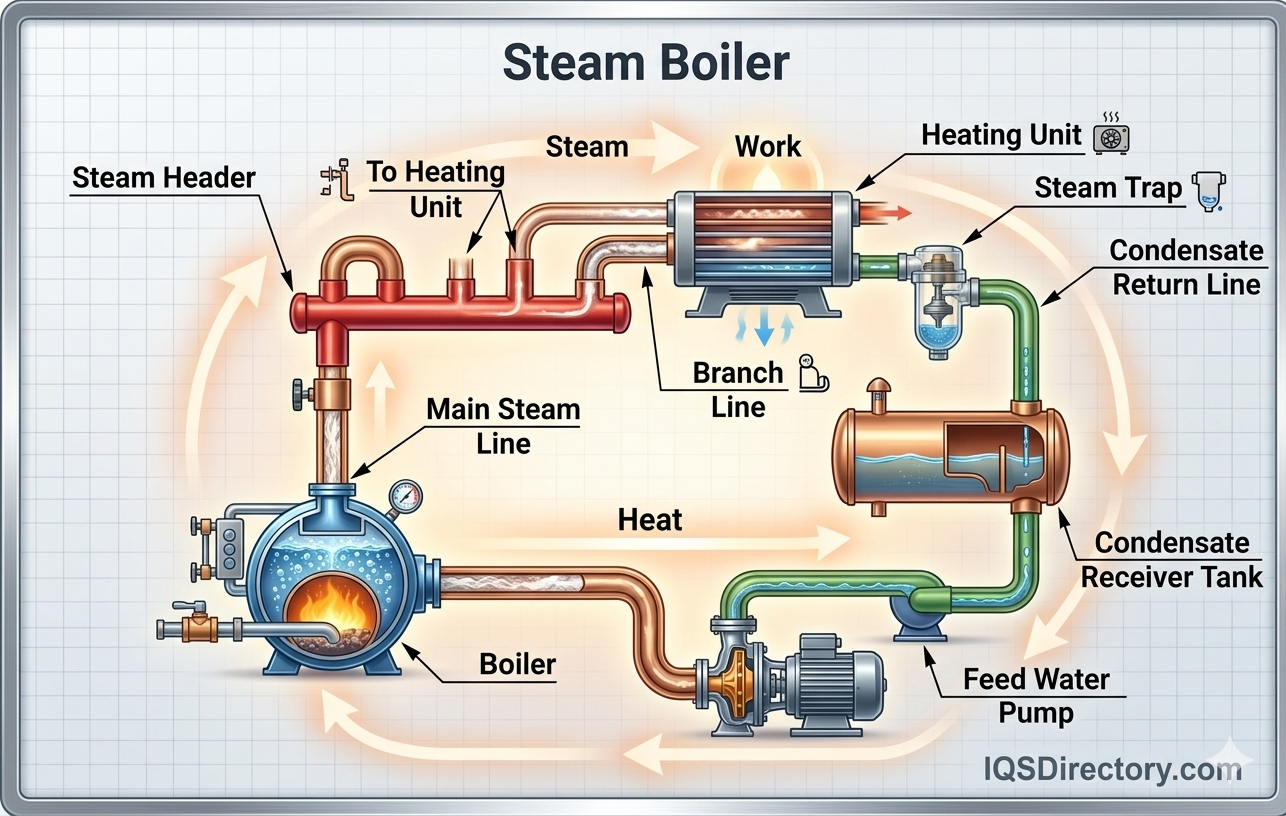
A steam boiler heats water past the boiling point — 212°F at standard pressure — converting it to steam. That steam travels upward through pipes to radiators throughout the house, releases its heat as it cools, condenses back into water, and drains back to the boiler by gravity to repeat the cycle.
The whole process runs at low pressure: most residential steam systems operate between 0.5 and 1.5 PSI. Despite that, the system generates a lot of heat per cycle, which is partly why steam-heated homes are known for warming up fast when temperatures drop hard overnight.
There are two configurations:
One-pipe steam systems use a single pipe that serves dual duty — steam travels up through it, and condensate drains back down through the same pipe. These are more common in older New England homes and require well-calibrated air vents on each radiator to function correctly.
Two-pipe steam systems separate the supply and return lines, giving more control over heat distribution. They're somewhat easier to balance across zones but represent a more complex installation.
What distinguishes steam systems from most other residential heating technology is that they move heat with no pump. The pressure differential does the work. That's an advantage in terms of mechanical simplicity — fewer moving parts — but it also means the system depends heavily on correct pipe slope, proper venting, and consistent water levels to function without banging, uneven heat, or pressure problems.
Forced hot water systems — often called hydronic heating — operate differently. Water is heated to roughly 160°F–180°F but never converts to steam. A circulator pump pushes that hot water through a closed loop of pipes to baseboard heaters, radiators, or in-floor radiant tubing, then returns the cooled water to the boiler to be reheated.
Because the system is closed and pressurized (typically 12–25 PSI), no water is lost in normal operation. The expansion tank absorbs pressure fluctuations as the water heats and cools.
Most modern residential boilers sold in the U.S. today are designed for forced hot water systems. High-efficiency condensing boilers — units that recover heat from exhaust gases and achieve efficiency ratings (AFUE) in the 90–98% range — are almost exclusively hot water boilers. This has significant implications for homeowners weighing long-term operating costs.
Forced hot water systems also support zoned heating more readily. Multiple thermostats, zone valves, or separate circulators can control different areas of a house independently. This isn't impossible with steam, but it's considerably easier to engineer with hydronic systems.
The geographic and architectural reasons for this split come down to when neighborhoods were built.
Steam heating dominated residential construction from roughly the 1880s through the 1950s. It required no electricity to distribute heat (a meaningful advantage before reliable household current), and it was well-suited to the cast iron radiators that were standard in multi-story homes of that era. Neighborhoods in Lowell, Lawrence, Chelmsford, and across Middlesex County still have a substantial share of pre-war homes running original or replacement steam systems.
Forced hot water systems largely replaced steam in new construction after mid-century. They were easier to zone, required less maintenance expertise, and integrated better with modern building practices. Suburban development across the Merrimack Valley from the 1960s onward tended toward hot water systems, and most homes built after 1980 in Massachusetts have hot water boilers.
The practical effect: if your home is pre-1960, you're likely on steam. If it was built after 1970, it's almost certainly forced hot water. Homes from the 1960s can go either way.
Heat delivery speed: Steam systems heat up fast and dump a lot of heat in a short cycle. This can create temperature swings — the room gets warm quickly, the boiler shuts off, and the room cools before the next cycle. Hot water systems, by contrast, maintain steadier temperatures with longer, lower-intensity cycles. Many homeowners find hot water heating more comfortable for this reason.
Noise: Steam systems are louder. The banging and hissing sounds often heard in older apartment buildings or pre-war homes are typically steam-related — either water hammer from condensate drainage issues, air vents releasing pressure, or pipes expanding. A well-maintained and properly balanced steam system runs quietly, but it requires more tuning to get there. Hot water systems with a functioning expansion tank and proper air bleeding run nearly silent.
Humidity: Steam adds moisture to the air as it heats. In dry New England winters, this is often considered a benefit. Hot water baseboard heating is drier by comparison, which is why some households using hot water heat run humidifiers during winter months.
Energy efficiency ceiling: This is where forced hot water systems have a clear structural advantage. The highest-efficiency gas boilers available today — units from manufacturers like Weil-McLain, Navien, and Buderus — are condensing hot water boilers. They achieve AFUE ratings of 95% and above. Steam systems cannot use condensing technology because the steam-to-condensate cycle operates at temperatures above the condensing threshold. The most efficient oil-fired steam boilers typically top out around 85% AFUE. For homeowners trying to reduce heating costs over a 15–20 year period, this efficiency gap is meaningful.
The two systems fail in different ways, and require different expertise to service properly.
Steam boiler common failure points:
Steam systems have fewer moving parts than hot water systems, but they require operators — plumbers and technicians — who understand the physics of steam pressure and the specific behavior of one-pipe versus two-pipe configurations. This expertise has become less common as steam systems age out of new construction. Finding a plumber who genuinely understands steam, rather than someone who has merely serviced it a few times, matters.
Forced hot water common failure points:
Hot water systems have more mechanical components but those components are well-standardized and widely understood. Parts are readily available and most licensed plumbers and HVAC technicians in Massachusetts work on these systems daily.
When a boiler reaches the end of its service life — typically 20–30 years for a well-maintained unit, though some steam boilers in New England are operating at 40+ years — homeowners face a decision about whether to replace in-kind or switch systems.
Replacing a steam boiler with another steam boiler is the lower upfront cost path. The existing distribution system (pipes, radiators, vents) is retained. There is no need to run new baseboards or in-floor tubing. For homes with high-quality cast iron radiators in good condition, this is often the most practical choice. The trade-off is accepting the efficiency ceiling of steam and committing to ongoing maintenance of a system type that requires specialized knowledge.
Converting from steam to forced hot water is a larger project. It involves installing new distribution equipment — typically baseboard heaters or in-floor radiant tubing — throughout the home, re-piping the system, and removing or repurposing existing steam components. Costs vary widely but can run $10,000–$25,000 or more for a full conversion in a multi-story New England home, depending on square footage and existing infrastructure.
The conversion can pay off over time, particularly if access to Mass Save rebates and financing is factored in — Massachusetts homeowners have access to 0% interest financing through the Mass Save program for qualifying high-efficiency heating equipment. However, the break-even timeline depends heavily on fuel costs, system efficiency, and how long the homeowner plans to stay in the home.
For a realistic assessment of which path makes financial sense for a specific property, a licensed plumbing and heating contractor who works with both system types is the right starting point. Companies like Ciardi Plumbing & Heating, which specialize in both steam and forced hot water systems in the Chelmsford and Merrimack Valley area, can evaluate a home's existing infrastructure and give a meaningful cost comparison rather than a generic recommendation.
Most comparison articles approach steam versus hot water as a consumer preference question — as if homeowners are selecting between two equivalent options. In practice, most Massachusetts homeowners don't choose: they inherit whichever system the house came with, and the decision is usually whether to maintain it or convert.
A few misconceptions worth correcting:
"Steam systems are obsolete." Not accurate. They're less common in new construction, but a properly maintained steam boiler in a pre-war home can be the most practical and cost-effective choice for that specific building. Older homes with cast iron radiators built into the walls aren't easily adapted to other systems without significant expense.
"Converting to forced hot water always saves money." It saves on operating costs over time, but the upfront conversion investment can take 10–15 years to recover depending on fuel prices. The math needs to be run on the specific home.
"Banging radiators mean the boiler is failing." Banging radiators almost always indicate a maintenance or calibration issue — usually a venting problem, a slope issue in the steam pipes, or a water level that's running too high. The boiler itself may be fine. A qualified technician can often resolve this without any equipment replacement.
What is the main operational difference between a steam boiler and a forced hot water boiler?
A steam boiler heats water until it converts to steam, which travels through pipes to radiators using pressure. A forced hot water boiler heats water to around 160–180°F and pumps it through a closed loop using a circulator. Steam systems use no pump; hot water systems rely on mechanical circulation. Both can use gas or oil as a fuel source.
Which type of boiler is more energy-efficient?
Forced hot water systems, particularly modern condensing boilers, achieve higher efficiency ratings — up to 95–98% AFUE. Steam boilers cannot use condensing technology due to their operating temperatures, and typically max out around 82–86% AFUE for newer units. Over the life of the system, this difference translates to measurable fuel cost savings for hot water systems.
Is it worth converting a steam system to forced hot water?
It depends on the home's age, condition of existing distribution equipment, and the homeowner's timeline. Conversion costs are substantial — often $10,000–$25,000 for a complete installation in a multi-story New England home. Mass Save financing can offset upfront costs. For homes with intact cast iron radiators and older steam systems in otherwise good condition, a like-for-like boiler replacement is often more practical.
Why do steam radiators make banging or hissing noises?
Banging usually results from condensate (water) becoming trapped in steam pipes due to poor slope or blocked return lines. Hissing typically comes from air vents releasing air to allow steam to enter. Neither is necessarily a sign of boiler failure — both are commonly resolved through maintenance, vent replacement, or pipe adjustment by a qualified technician.
How long do steam boilers typically last in Massachusetts?
A well-maintained residential steam boiler has a service life of 20–30 years. Some cast iron boilers in New England last 40 years or longer with proper care. Annual tune-ups, consistent water quality monitoring, and timely replacement of vents and safety controls extend service life significantly.
Are there any Massachusetts incentives for upgrading to a high-efficiency boiler?
Yes. The Mass Save program, administered through Massachusetts utilities, offers 0% interest loans for qualifying energy-efficient heating equipment installations. High-efficiency gas boilers (90% AFUE and above) typically qualify. Homeowners should contact their utility provider or a participating heating contractor to confirm current program terms, as offerings vary by provider and are updated periodically.