 English
 Arabic
 French
 Spanish
 Portuguese
 Deutsch
 Turkish
 Dutch
Dutch
 Italiano
 Russian
 Romaian
 Portuguese (Brazil)
 Greek
Greek
Low Voltage Energy Distribution Market Research Report: Industry Size, Share & Future Opportunities
Home |
2026-07-01 12:55:31
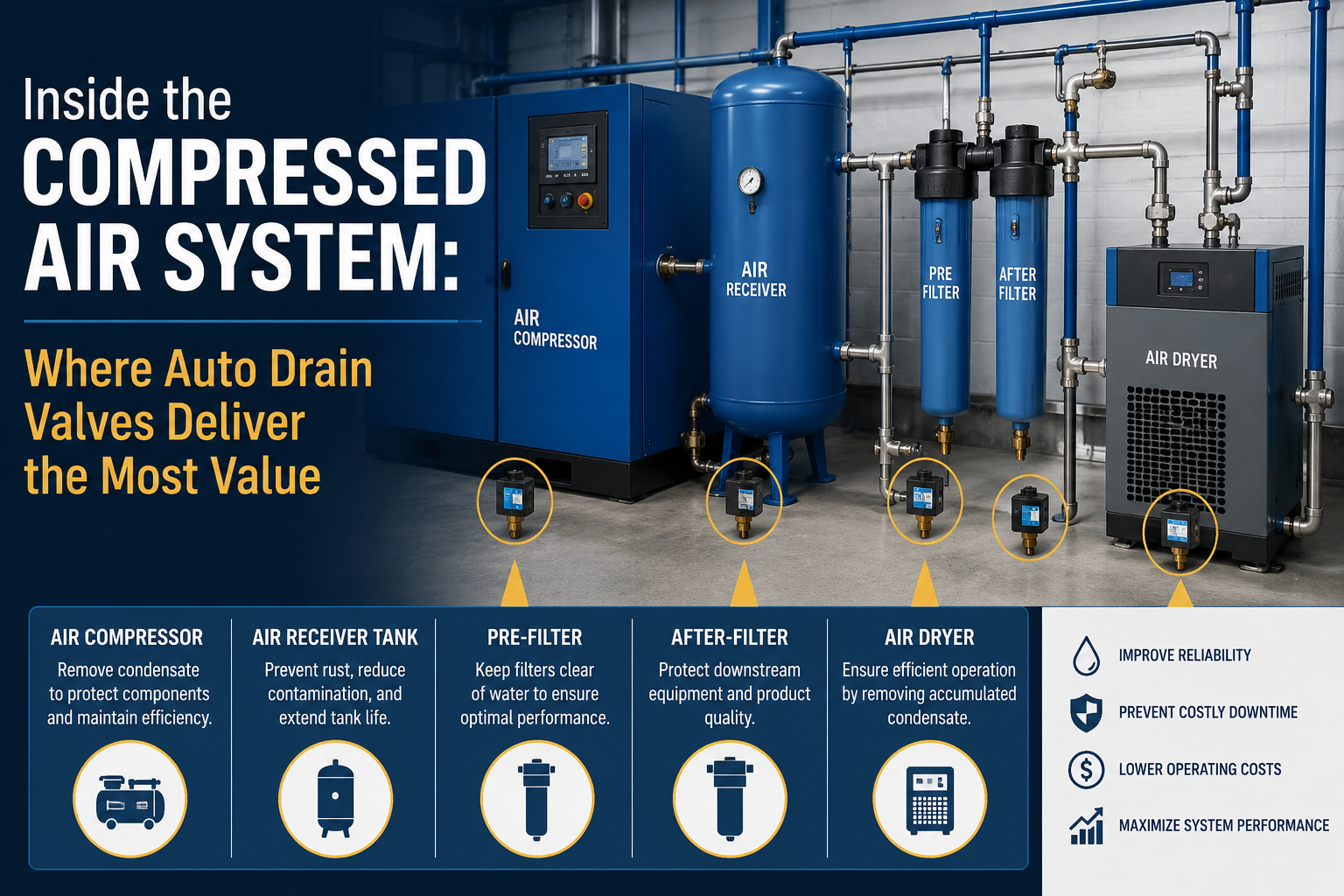
The receiver tank has been sitting at the far end of the compressor room for six years. Nobody's drained it properly in three months because the maintenance schedule slipped and the manual ball valve handle is corroded halfway open. Last week, a pneumatic cylinder on the assembly line started moving erratically. The maintenance crew replaced the seals twice. Nobody checked the condensate level in the receiver until the third call-out. That's two days of partial line stoppage and four hours of labour for a problem an Auto Drain Valve would have prevented entirely.
This is not an unusual story.
Most buyers approach auto drain valve procurement the same way — pick a type, confirm the pressure rating, place the order. What they miss is that placement within the compressed air system determines whether the valve actually solves the problem or just adds hardware to the pipe. Different points in the network accumulate condensate at different rates and with different contamination profiles. Specifying the same valve across every drain point is a shortcut that costs more to maintain than getting the placement right from the start.
The receiver is where the largest volume of condensate collects. Air enters hot from the compressor aftercooler, cools inside the receiver vessel, and deposits moisture at the bottom. In Indian operating conditions — ambient humidity frequently above 70% from June through September — a 500-litre receiver on a 75 kW compressor can accumulate 8 to 20 litres of condensate per 8-hour shift depending on inlet conditions.
A float-type or electronic timer drain valve installed at the lowest drain port handles this load reliably. The receiver is also the least pressure-sensitive drain point, which means a basic float drain works well here without over-specifying. Most Auto drain valve manufacturers stock receiver-compatible float drains as standard catalogue items.
After the receiver, compressed air typically passes through a refrigerant dryer and coalescing filters before distribution. These are the second-highest condensate accumulation points. Filter bowls fill faster than most maintenance schedules account for, particularly in high-throughput systems. An auto drain valve on each filter housing keeps the bowl clear and maintains filter performance — a saturated filter bowl bypasses moisture directly into the downstream line.
That's the detail buyers miss most often: a filter that looks fine from the outside is often operating at reduced efficiency because the bowl hasn't been drained in a week.
Long horizontal runs of compressed air piping collect condensate at low points and direction changes. Drip legs — short vertical drops installed at these collection points — gather that condensate and hold it until it's drained. Manual draining of drip legs gets skipped on night shifts and weekends with regularity. Auto drain valves on drip legs eliminate that dependency entirely. For plants with long pipeline runs, this is often where the payback on auto drain valves shows up fastest — not at the receiver, but in the distribution network.
Pneumatic tools, spray guns, and precision actuators are the most moisture-sensitive points in the whole system. A small inline drain or water separator with an automatic drain valve immediately upstream of critical equipment is the last line of protection. Even plants with well-maintained receivers and filters occasionally pass moisture during high-demand spikes. Point-of-use protection catches what the upstream system misses.
The overlooked specification: Thread size and body orientation. Point-of-use drain valves in tight equipment installations require compact bodies — sometimes as small as 1/8" BSP connections — and mounting positions that don't interfere with adjacent components. Buying a standard-catalogue drain valve and expecting it to fit everywhere in the pipeline without checking this creates installation problems that show up at commissioning, not in the purchase order.
1. Do they specify valves by installation point or just by pressure rating? A supplier who asks where the valve is going — receiver, filter, drip leg, or point-of-use — is applying application knowledge. One who just confirms operating pressure and sends a price is moving stock. That distinction matters when you're specifying for a new plant build or a systematic upgrade across 12 drain points with different condensate volumes. The bad answer: "all our drain valves work up to 16 bar." Full stop.
2. Can they provide condensate capacity data by model? Volume throughput — litres per hour of condensate the valve can handle — varies significantly across types and sizes. A valve rated for 200 litres per hour installed on a drain point generating 600 litres per hour will cycle constantly, wear faster, and eventually fail open. Reliable Auto Drain Valve suppliers in India have this data on their spec sheets. If it's not there, it wasn't tested.
3. What's their policy on defective units from a production batch? An auto drain valve manufacturer who says "send us photos and we'll assess case by case" after delivery doesn't have a return policy. That's a negotiation you'll lose after the shipment lands, especially on an import order. Ask before you order: what percentage defect rate triggers a replacement batch? What documentation do they need? Get it in the purchase agreement.
4. Do they stock parts — or just complete units? Float assemblies, solenoid coils, and seal kits wear out. A supplier who only sells complete valves means every maintenance event is a full unit replacement. For large installations with 20 or 30 drain points, seal kit availability is a real lifecycle cost. Auto Drain Valve manufacturers who stock spares separately are set up for long-term supply relationships. Traders who only move finished goods typically aren't.
5. Can they confirm delivery timelines in writing? Lead time verbals from suppliers are not commitments. An auto drain valve trader in India promising 10-day delivery and delivering in 28 days is not an unusual experience in this category. If the timeline matters to your project schedule — and it usually does — get the committed date written into the order acknowledgement with a clear provision for what happens if it slips.
Downstream Pneumatic Equipment from Moisture Damage Water in a pneumatic actuator causes corrosion of the cylinder bore and premature seal failure. Replacing a single mid-specification actuator in an automated line runs between ₹20,000 and ₹80,000 depending on bore size and stroke length — before you add the cost of downtime and the labour to pull and reinstall it. Auto drain valves placed correctly across the system eliminate the root cause of that failure mode.
Filter Efficiency and Replacement Frequency Coalescing filters working against a saturated bowl don't filter. They pass contaminated air and create a false sense of security. Plants that add auto drain valves to filter housings consistently report longer filter element life — typically 20 to 35% longer between element changes, based on field feedback across comparable installations. That's a direct reduction in consumable spend.
Production Continuity on High-Uptime Lines A pharmaceutical filling line, a continuous casting operation, or an automotive paint booth cannot absorb unplanned stoppages for condensate-related failures. Auto drain valves on every accumulation point in the compressed air network are not optional for high-uptime production — they're infrastructure, not accessories.
Compressed Air Quality Certification Compliance Meeting ISO 8573 Class 1 or Class 2 air quality requirements for moisture depends on active condensate removal at every stage of the distribution system. Spot checks that find water in filter bowls during a certification audit create expensive problems. Systematic auto draining is what makes clean air certification maintainable, not just achievable on audit day.
Maintenance Labour Reallocation Every manual drain point in a plant requires a person to check it on a schedule — and that schedule gets skipped. Across a plant with 15 manual drain points running three shifts, the cumulative labour and the missed drain events add up to a measurable cost. Auto drain valves remove the dependency on human scheduling without removing the maintenance record, since electronic variants can log actuation events.
India's pneumatic component manufacturing base is strongest in Gujarat — particularly Rajkot and Ahmedabad — and in Pune, Maharashtra. These regions supply both domestic industrial buyers and international procurement accounts, with established export logistics through western seaports.
For buyers in southern India — Bangalore, Chennai, Hyderabad — a network of Auto Drain Valve suppliers in India maintains regional stock of standard variants. Lead times for standard models from these distribution points run 3 to 7 days for domestic orders. Non-standard specifications or OEM-requirement units require direct engagement with the Auto Drain Valve manufacturer.
Auto Drain Valve traders in India operate primarily in finished-goods distribution. They're useful for standard catalogue procurement with known specifications and short lead times. For projects requiring application-specific valve selection, technical documentation, or compliance support for export markets, a manufacturer is the correct source. Mixing the two up — going to a trader for a specification-sensitive purchase — is where procurement mistakes get expensive.
We manufacture and export pneumatic components, including a full range of auto drain valves, from our ISO-certified facility in India. We currently supply customers across 31 countries, covering Asia, the Middle East, Africa, and parts of Europe.
We've done enough plant visits over the years to know that drain valve problems almost always start with placement decisions made at project design stage that nobody revisits until something fails. We try to catch that earlier. When a procurement enquiry comes in for a large quantity of identical drain valves across multiple installation points, we ask about the application before we send a price. Sometimes that conversation changes the specification. We'd rather spend 20 minutes getting it right than handle a return claim three months later.
One thing worth knowing: we updated our float assembly material specification for receiver-duty valves in 2023 after two buyers in high-temperature Gulf installations reported float coating degradation at sustained temperatures above 65°C. The revised specification uses a higher-grade material that we now apply as standard across all receiver-duty models. That change came from post-installation feedback, not from a lab test. That's how 12 years of export supply actually works.
If you're specifying Auto drain valves for a new installation or replacing existing drain points, send us the number of drain points, installation locations (receiver, filter, drip leg, or point-of-use), operating pressure, and whether the application is standard industrial or involves aggressive condensate (oily, acidic, or high-particulate). We respond to specification enquiries within 24 hours on business days.
Minimum sample quantity: 2 units per variant. Bulk order MOQ varies by model — confirmed in the quotation. Contact us directly through vspneumatic with your specification details or project BOM.
Buying an Auto Drain Valve without knowing where it's going in the system is the procurement equivalent of specifying a pump without knowing the flow rate. The component category is straightforward — the application detail is where the value is or isn't delivered. Work with an Auto Drain Valve manufacturer who asks the right questions before quoting, and you'll spend less fixing specification mismatches after installation. The plants that get compressed air maintenance right treat drain valve placement as a design decision, not an afterthought.
Q1: How many Auto Drain Valves does a typical compressed air system need?
It depends on the system layout, not on any fixed rule. At minimum, you need one at the air receiver, one per filter housing, and one at each drip leg in the distribution pipework. A plant with a single compressor, one dryer, two filter stages, and a 30-metre distribution run might need 6 to 8 drain valves. A multi-compressor facility with long distribution networks and multiple production zones could need 20 or more. Any Auto Drain Valve supplier in India who quotes a fixed number without asking about your system layout is guessing.
Q2: What's the right auto drain valve type for a receiver tank versus a filter housing?
Receiver tanks handle high condensate volumes and tolerate larger, float-type drain valves well. Filter housings are typically smaller, with less condensate volume but tighter space constraints — compact electronic timer drains or miniature float drains are more appropriate there. Using a large receiver-duty valve on a filter housing creates installation problems and usually means the valve never drains correctly because the condensate volume never reaches the float threshold. That's a common mistake with real consequences for filter performance.
Q3: Can I use a single valve specification across all drain points to simplify procurement?
You can, but it typically means over-specifying some points and under-specifying others. A compromise specification that fits every installation point rarely performs optimally at any of them. The procurement simplification saves time on ordering and stocking — but it tends to show up as higher maintenance frequency and shorter valve service life at the points where the spec doesn't match the load. Honest caveat: for small plants with fewer than 6 drain points, a single standardised valve often makes practical sense even if it's not theoretically optimal.
Q4: How do I find a reliable Auto Drain Valve manufacturer in India for OEM supply?
Look for ISO certification, active export history, and the ability to provide product-specific test documentation. Auto Drain Valve manufacturers in India with genuine OEM supply capability maintain technical datasheets, accept specification modifications, and can provide factory test records per batch. An Auto Drain Valve trader operating as a middleman can fulfil standard stock but typically cannot support OEM documentation requirements or non-standard specifications. Clarify which you're dealing with before the order is placed.
Q5: What causes an auto drain valve to fail open and continuously bleed air?
Three common causes: float assembly fouled with oil or particulate and stuck in the open position; solenoid coil failure on a timer-controlled valve leaving the solenoid energised; or a damaged seat allowing air to bypass even when the valve should be closed. In all three cases, the symptom is the same — continuous air loss from the drain port. The fix depends on root cause. Caveat: continuous air bleed from a drain valve on a high-pressure receiver can waste significant compressed air volume before it's noticed. If your system has unexplained compressor run-time increases, this is worth checking early.
Q6: Are Auto Drain Valve suppliers in India able to supply for export projects?
ISO-certified Auto Drain Valve manufacturers in India with active export programmes maintain the compliance documentation — CE certificates, pressure equipment test records, country-of-origin documentation — that international projects require. Standard traders may not have this on file even for products that technically meet the specification. For export procurement, request documentation as a condition of the purchase order rather than assuming it's included.
Q7: What maintenance does an auto drain valve actually need, and how often?
At minimum: inspect every 3 months for correct actuation, clean the strainer or inlet screen every 6 months, and replace seal kits every 2 to 3 years depending on condensate quality. Float-type valves in high-particulate environments need more frequent strainer cleaning. Electronic timer valves need solenoid coil checks every 2 years in high-cycle applications. The harder reality buyers don't hear often enough: plants that install auto drain valves and then assume they're maintenance-free create a different category of failure — one that's harder to diagnose because the valve looks operational but isn't draining correctly. Schedule the inspection. It takes 10 minutes per valve.
