Mental health practices across the USA face growing administrative challenges. Between changing insurance policies, evolving documentation standards, and increasing patient demand, providers often spend valuable time managing claims instead of focusing on patient care. This is where choosing a professional mental health billing company can make a meaningful difference.
Whether you operate a private therapy practice, a psychiatry clinic, a behavioral health center, or a multidisciplinary healthcare organization, effective billing processes directly impact your financial stability. Clean claims, timely reimbursements, and accurate coding help practices reduce delays while improving the overall patient experience.
This guide explains what a professional mental health billing company does, the services you should expect, and how to choose the right partner for your practice.
Why Mental Health Billing Requires Specialized Expertise
Mental health billing is not the same as billing for other medical specialties. Behavioral healthcare involves unique coding requirements, varying payer rules, authorization procedures, and documentation expectations.
Common challenges include:
- Insurance verification before appointments
- Prior authorization requirements
- Telehealth billing regulations
- Time-based psychotherapy coding
- Multiple provider credential requirements
- Frequent payer policy updates
- Coordination of benefits
- Managing denied or underpaid claims
Without specialized knowledge, even small billing mistakes can result in payment delays or claim denials.
A professional billing team understands these complexities and helps practices maintain accurate financial operations while staying compliant with industry standards.
What Does a Professional Mental Health Billing Company Do?
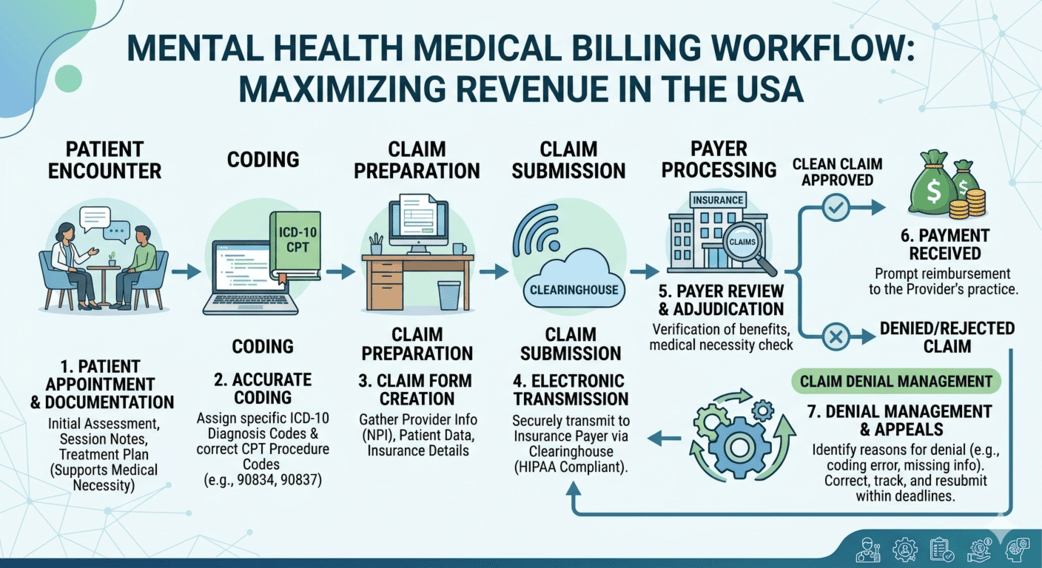
A dedicated billing company manages the financial side of a behavioral healthcare practice from the patient's first appointment until the final payment is collected.
Their responsibilities often include:
Insurance Eligibility Verification
Before treatment begins, verifying insurance coverage helps prevent billing surprises. Proper eligibility checks confirm:
- Active insurance plans
- Mental health benefits
- Copayment responsibilities
- Deductible status
- Authorization requirements
This step reduces claim rejections later in the billing cycle.
Accurate Medical Coding
Correct coding is one of the most important parts of mental health billing.
Experienced professionals understand psychotherapy, psychiatric evaluation, medication management, crisis intervention, and telehealth coding requirements. Their expertise in medical coding services helps practices submit cleaner claims with fewer errors.
Claim Submission
After coding is completed, claims are prepared and submitted to insurance carriers promptly.
Accurate claim submission improves:
- First-pass acceptance rates
- Faster reimbursements
- Reduced administrative workload
- Better cash flow
Denial Management
Denied claims are common in behavioral healthcare. However, they should never be ignored.
Professional billing specialists:
- Identify denial reasons
- Correct claim errors
- Submit appeals
- Track claim status
- Recover missed reimbursements
Consistent denial management prevents revenue loss over time.
Payment Posting and Reporting
Once payments are received, every transaction should be recorded accurately.
Regular financial reports allow providers to monitor:
- Outstanding claims
- Collection trends
- Insurance performance
- Revenue growth
- Accounts receivable aging
These reports support better business decisions.
Benefits of Working with a Professional Mental Health Billing Company
Many providers initially manage billing internally. As patient volume grows, administrative responsibilities can quickly become overwhelming.
Partnering with specialists offers several advantages.
More Time for Patient Care
Therapists, psychologists, psychiatrists, and counselors enter healthcare to help patients—not spend hours correcting insurance claims.
Outsourcing billing allows providers to focus on clinical care while experienced professionals manage administrative tasks.
Improved Cash Flow
Clean claims are processed faster, helping practices receive payments more consistently.
Reliable billing processes reduce delays that can interrupt daily operations.
Lower Claim Denial Rates
Experienced billing specialists understand payer-specific guidelines and documentation requirements.
This knowledge significantly reduces common billing mistakes that lead to claim denials.
Better Compliance
Healthcare regulations continue to evolve.
Professional billing companies stay informed about coding updates, payer policy changes, and documentation requirements, helping practices remain compliant while reducing audit risks.
Scalable Support
As practices expand by adding providers, new locations, or additional behavioral health services, billing requirements become more complex.
An experienced billing partner can scale services without disrupting existing workflows.
Essential Features to Look for in a Billing Partner
Not every billing company specializes in behavioral healthcare. Choosing the right partner requires careful evaluation.
Consider companies that offer:
- Experience with mental health specialties
- Certified coding professionals
- Insurance verification services
- Prior authorization support
- Telehealth billing expertise
- Transparent financial reporting
- Strong denial management processes
- HIPAA-compliant workflows
- Responsive customer support
- Experience with multiple insurance payers
The goal is to find a long-term partner that understands both clinical workflows and healthcare reimbursement.
The Role of Credentialing in Mental Health Billing
Many reimbursement issues begin before a claim is ever submitted.
If providers are not enrolled correctly with insurance companies, claims may be delayed or rejected.
Professional credentialing services help ensure providers are properly enrolled and maintain participation with insurance networks.
Credentialing typically includes:
- Provider enrollment
- License verification
- CAQH profile maintenance
- Revalidation assistance
- Insurance payer applications
Keeping credentialing current helps practices avoid unnecessary payment interruptions.
How Revenue Cycle Management Supports Financial Stability
Billing is only one part of the financial process.
Complete revenue cycle management covers every stage of patient revenue, including:
- Appointment scheduling
- Insurance verification
- Patient registration
- Medical coding
- Claim submission
- Payment posting
- Denial resolution
- Patient collections
- Financial reporting
When every stage works together efficiently, practices experience healthier cash flow and fewer administrative bottlenecks.
Signs Your Practice May Need Professional Billing Support
Many behavioral healthcare providers wait until billing problems become overwhelming before seeking help.
Consider professional support if your practice experiences:
- Increasing claim denials
- Slow insurance reimbursements
- High accounts receivable
- Frequent coding errors
- Staff overwhelmed with administrative work
- Difficulty tracking unpaid claims
- Reduced monthly collections
- Limited visibility into financial performance
Addressing these issues early helps protect long-term financial health.
Supporting Practice Growth Through Specialized Billing
As mental health services continue to expand across the USA, providers need reliable operational support alongside quality patient care.
A professional mental health billing company contributes to practice growth by improving billing accuracy, streamlining reimbursement processes, and reducing administrative stress.
Organizations such as 247 Medical Billing Services provide specialized healthcare solutions that may include medical billing services, medical coding services, credentialing, and comprehensive revenue cycle management. Working with experienced professionals allows behavioral health providers to focus on delivering compassionate care while maintaining organized financial operations.
Ultimately, the right billing partner should function as an extension of your practice—helping improve efficiency, minimize claim issues, and support sustainable growth without compromising compliance or patient satisfaction.
Frequently Asked Questions
1. What is a professional mental health billing company?
A professional mental health billing company specializes in handling insurance claims, coding, payment posting, denial management, and reimbursement processes specifically for behavioral healthcare providers.
2. Why is mental health billing different from general medical billing?
Mental health billing involves unique psychotherapy codes, telehealth regulations, authorization requirements, and payer-specific documentation guidelines that require specialized expertise.
3. How can outsourced billing improve practice revenue?
Experienced billing professionals submit cleaner claims, reduce denials, speed up reimbursements, and identify missed revenue opportunities, leading to healthier cash flow.
4. What services are typically included?
Most companies provide insurance verification, claim submission, coding support, denial management, payment posting, reporting, credentialing, and revenue cycle management services.
5. Is outsourcing mental health billing secure?
Reputable billing companies follow HIPAA compliance standards, maintain secure systems, and protect sensitive patient information throughout the billing process.
6. Can small private practices benefit from professional billing services?
Yes. Independent therapists, psychologists, psychiatrists, and counseling practices often benefit from reduced administrative work and improved reimbursement efficiency.
7. How do I choose the right mental health billing company?
Look for industry experience, behavioral health expertise, transparent reporting, strong coding knowledge, effective denial management, compliance practices, and responsive customer support.
 English
 Arabic
 French
 Spanish
 Portuguese
 Deutsch
 Turkish
 Dutch
Dutch
 Italiano
 Russian
 Romaian
 Portuguese (Brazil)
 Greek
Greek