Introduction
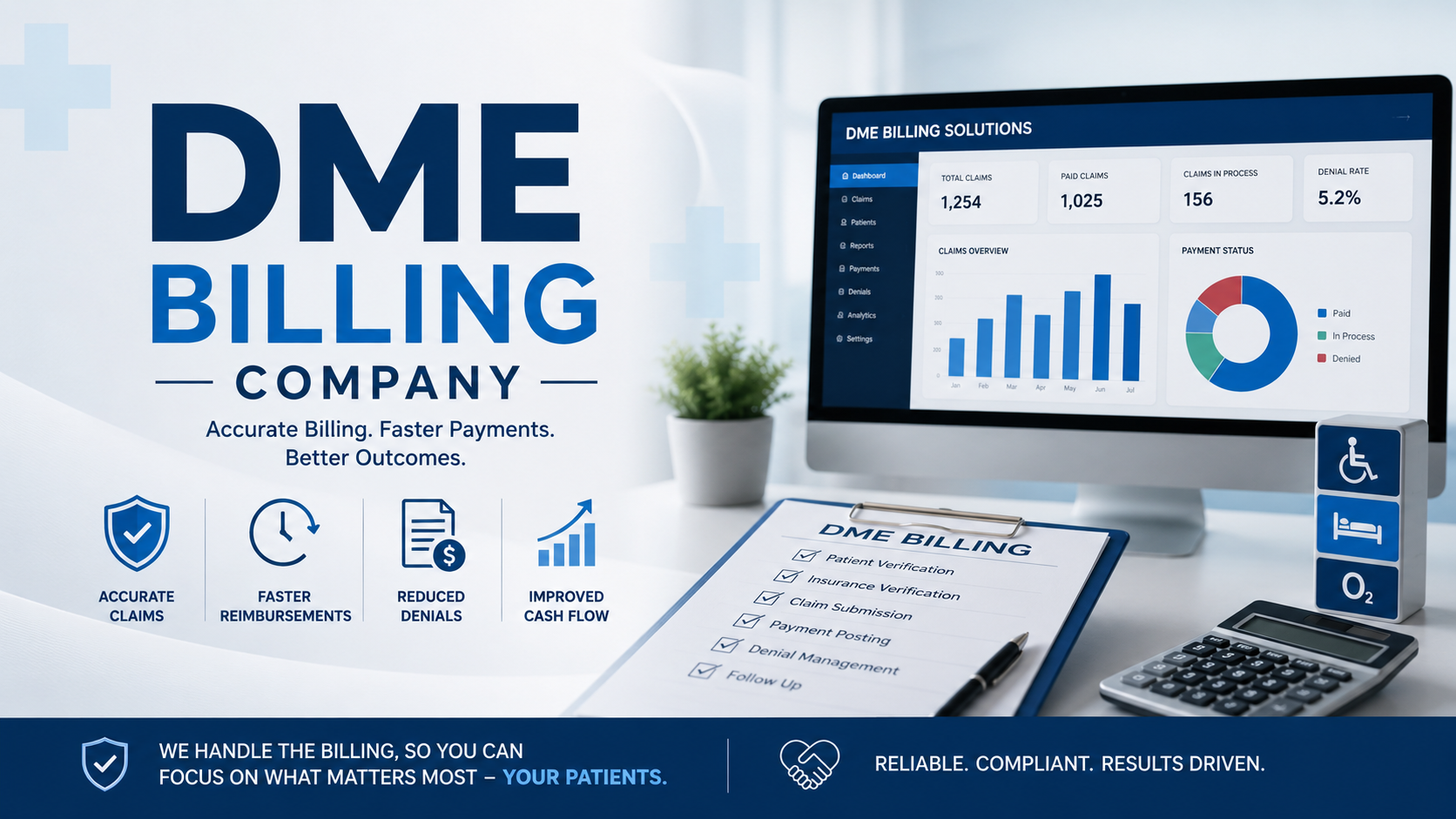
Durable Medical Equipment (DME) billing is one of the most complex and detail-driven areas of the healthcare revenue cycle. From strict payer guidelines to constantly changing coding requirements, even small errors can lead to claim denials, delayed reimbursements, and revenue leakage. For many healthcare providers and suppliers, managing these complexities in-house becomes overwhelming and resource-intensive.
This is where DME billing outsourcing has become a practical solution. By partnering with specialized billing experts, providers can streamline operations, reduce administrative burden, and improve cash flow. Instead of struggling with documentation errors, eligibility checks, and claim rework, healthcare organizations can focus more on patient care and business growth.
In today’s competitive healthcare environment, outsourcing DME billing is no longer just a cost-saving measure—it is a strategic move toward accuracy, compliance, and scalability.
Understanding the Complexity of DME Billing
DME billing is not like standard medical billing. It involves a unique set of rules, documentation requirements, and payer-specific policies that must be followed precisely. Items such as wheelchairs, oxygen equipment, CPAP machines, and orthopedic devices require prior authorization, detailed medical necessity proof, and ongoing compliance tracking.
One of the biggest challenges providers face is maintaining accuracy across multiple payer systems. Each insurance company has different guidelines for coverage, modifiers, and claim submission timelines. A minor mismatch in coding or missing documentation can easily result in claim rejection.
Another major challenge is the constant regulatory updates. CMS guidelines and payer policies change frequently, and keeping an internal team updated requires continuous training and monitoring. For smaller practices or DME suppliers, this becomes time-consuming and expensive.
Additionally, DME billing involves a high level of follow-up. Claims often require repeated status checks, appeal submissions, and correction cycles before payment is received. Without a dedicated system in place, revenue cycles become delayed and unpredictable.
These complexities are the primary reason many providers are shifting toward DME billing outsourcing to improve accuracy and efficiency.
Key Benefits of DME Billing Outsourcing
Outsourcing DME billing offers several operational and financial advantages that directly impact revenue cycle performance. It is not just about reducing workload—it is about improving the entire billing ecosystem.
1. Improved Claim Accuracy and Fewer Denials
One of the most immediate benefits of outsourcing is improved claim accuracy. Professional billing teams are trained specifically in DME coding guidelines, payer requirements, and documentation standards. This reduces the chances of errors that typically lead to claim denials.
With a dedicated team reviewing each claim before submission, issues such as missing modifiers, incorrect HCPCS codes, or incomplete medical necessity documentation are significantly reduced. As a result, providers experience higher first-pass claim acceptance rates.
2. Faster Reimbursements and Better Cash Flow
Delayed reimbursements are a common problem in DME billing. Outsourcing helps accelerate the entire billing cycle—from eligibility verification to claim submission and follow-up. Since specialized teams work on real-time claim tracking, delays are minimized.
Faster processing means improved cash flow, which is crucial for DME suppliers who rely on timely payments to maintain inventory and operations. Efficient follow-up processes also ensure that no claim is left unattended or forgotten.
3. Reduced Operational Costs
Maintaining an in-house DME billing team requires investment in salaries, training, software, and infrastructure. Outsourcing eliminates many of these overhead costs. Providers only pay for the services they use, making it a cost-effective solution.
Additionally, it reduces the financial impact of denied claims and rework efforts. Since experienced professionals handle the billing process, costly errors are minimized, leading to better overall financial performance.
4. Access to Specialized Expertise and Technology
DME billing outsourcing companies bring industry-specific expertise and advanced billing tools to the table. These tools often include automated claim scrubbing, eligibility verification systems, and denial management dashboards.
This level of technology is often expensive for small or mid-sized providers to implement independently. Outsourcing gives them access to these systems without heavy investment, ensuring higher efficiency and compliance.
How DME Billing Outsourcing Improves Compliance and Scalability
Compliance is a critical aspect of DME billing. Regulations from CMS and private payers require strict adherence to documentation, coding accuracy, and audit readiness. Failure to comply can result in penalties, audits, or even loss of reimbursement privileges.
Outsourced billing teams are typically well-versed in compliance standards and continuously update their processes based on regulatory changes. This ensures that claims are submitted correctly the first time, reducing audit risks and compliance issues.
Another major advantage is scalability. As a DME business grows, billing volume increases significantly. Managing this growth internally often requires hiring and training additional staff. With outsourcing, scalability becomes seamless. Providers can easily handle increased claim volumes without worrying about staffing constraints or workflow disruptions.
This flexibility allows businesses to expand into new markets or service areas without being restricted by internal billing capacity.
Common Challenges Solved by DME Billing Outsourcing
Many healthcare providers choose outsourcing after facing recurring operational challenges. Some of the most common issues resolved include:
- Frequent claim denials due to documentation errors
- Delays in insurance verification and authorization
- Lack of follow-up on unpaid or rejected claims
- Difficulty in managing multiple payer requirements
- High administrative workload on internal staff
By addressing these challenges, outsourcing helps create a more stable and predictable revenue cycle. It also improves staff productivity by allowing internal teams to focus on core clinical or operational responsibilities instead of billing complexities.
Choosing the Right DME Billing Outsourcing Partner
Selecting the right outsourcing partner plays a crucial role in achieving desired results. Not all billing vendors offer the same level of expertise or service quality. Providers should evaluate partners based on experience, technology capabilities, and compliance standards.
Key factors to consider include:
- Proven experience in DME billing processes
- Strong understanding of payer guidelines and CMS regulations
- Use of advanced billing and denial management tools
- Transparent reporting and communication systems
- Dedicated account management and support
A reliable partner should function as an extension of your internal team, ensuring smooth collaboration and consistent performance.
FAQ: DME Billing Outsourcing
1. What is DME billing outsourcing?
DME billing outsourcing is the process of delegating durable medical equipment billing tasks such as coding, claim submission, follow-up, and denial management to a specialized external service provider.
2. Why should providers outsource DME billing?
Providers outsource DME billing to reduce claim errors, improve cash flow, lower operational costs, and ensure compliance with complex payer regulations.
3. Is outsourcing DME billing cost-effective?
Yes, outsourcing is generally more cost-effective than maintaining an in-house billing team because it reduces staffing, training, and technology expenses while improving claim success rates.
4. How does outsourcing improve claim approvals?
Outsourced billing teams use specialized knowledge and automated claim scrubbing tools to ensure accurate coding and complete documentation, which increases first-pass claim approvals.
5. Can small DME suppliers benefit from outsourcing?
Absolutely. Small suppliers benefit the most because outsourcing allows them to access expert billing services without investing heavily in infrastructure or staff.
Conclusion
In a healthcare environment where efficiency and accuracy directly impact revenue, DME billing outsourcing has become a strategic necessity rather than just an option. It helps providers overcome billing complexities, reduce administrative burden, and achieve faster reimbursements while maintaining compliance with evolving regulations.
By partnering with experienced billing professionals, healthcare organizations can transform their revenue cycle into a more predictable and efficient system. This not only improves financial stability but also allows providers to focus on delivering better patient care.
For organizations looking to strengthen their billing performance and eliminate revenue leakage, partnering with reliable Medical Billing Services can be the key to long-term success.
 English
 Arabic
 French
 Spanish
 Portuguese
 Deutsch
 Turkish
 Dutch
Dutch
 Italiano
 Russian
 Romaian
 Portuguese (Brazil)
 Greek
Greek