English
 Arabic
 French
 Spanish
 Portuguese
 Deutsch
 Turkish
 Dutch
Dutch
 Italiano
 Russian
 Romaian
 Portuguese (Brazil)
 Greek
Greek
Healthcare Blister Packaging Industry Outlook 2035: Pharmaceutical Packaging Growth
Other |
2026-08-13 06:53:52
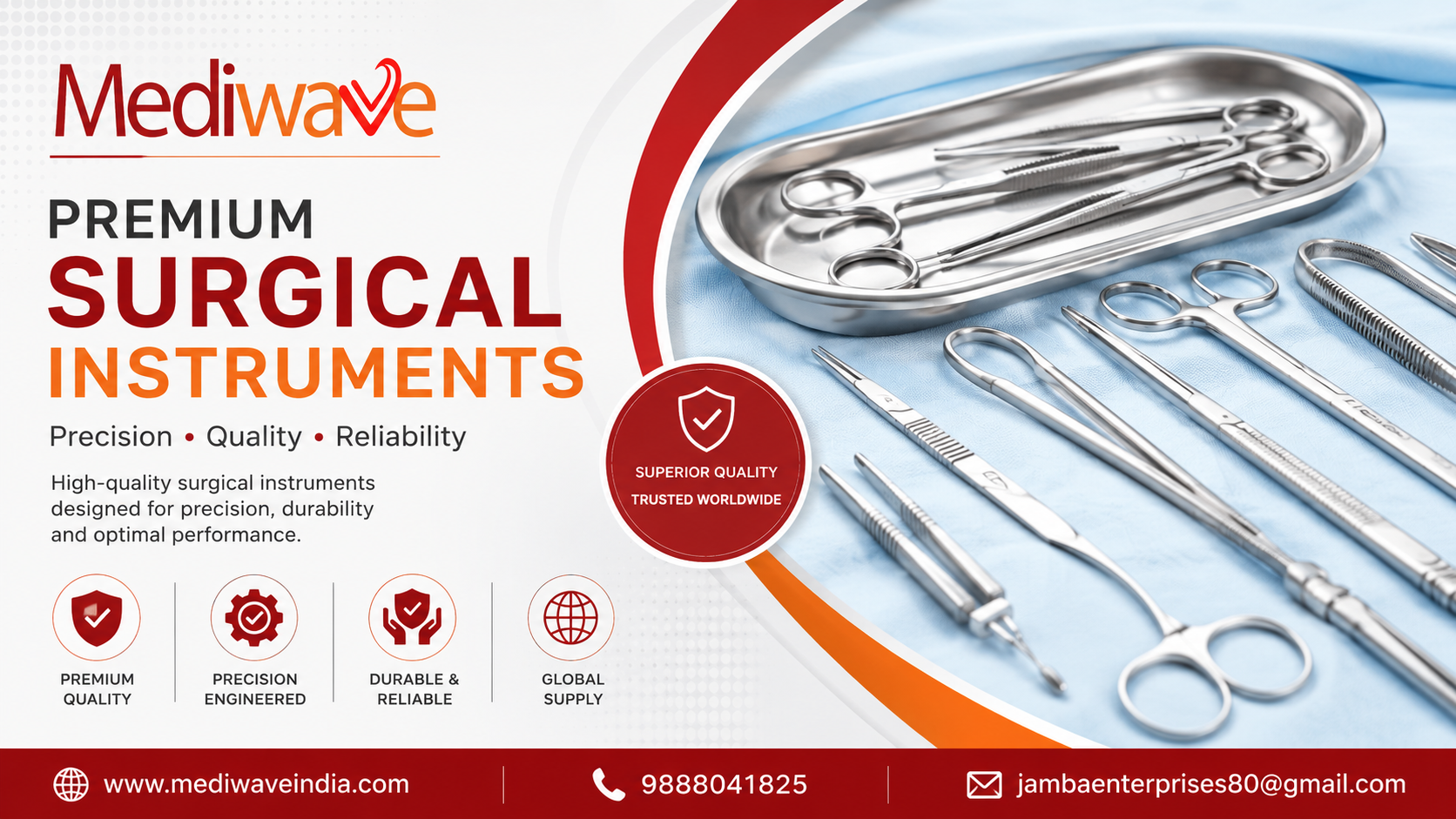
A clamp that slips by even 1 mm can slow a procedure, annoy a surgeon, and put the procurement team back under pressure. That’s why Surgical Instruments buying is not a “lowest quote wins” decision. India’s medical devices market was estimated at US$11 billion in 2022 and is projected to reach US$50 billion by 2030, so buyers now have more options — and more room to make costly supplier mistakes.
Mediwave India works across surgical, orthopedic, dental, ENT, gynecology, neurosurgery, cardiovascular, diagnostic, urology, and tray/accessory categories listed on its website. That range matters because hospitals rarely buy one item in isolation.
Forceps, scissors, retractors, probes, surgical sets, bone saws, clamps, and trays each perform differently when held in the hand. This is what purchasers overlook: the relationship between jaw alignment, gripping action, surface texture, ability to withstand sterilization, and durability of the edge defines the instrument’s performance over time.
A vendor who says only “stainless steel” does not answer the question.
According to the Indian Medical Device Rules, 2017, a transient-use surgically invasive reusable surgical instrument falls into Class A. This may seem to be safe enough, yet poor finishing, poor joints and sharp edges may cause clinical problems. Thus, the specification for the item must include its material, finish, size range, sterilization process and packaging, among other details.
Most buyers compare three quotes and think the job is done. It isn’t.
A good supplier explains grade, finish, corrosion resistance, and usage suitability. A bad answer sounds like: “same quality, sir, don’t worry.”
Mediwave lists surgical forceps, scissors, retractors, probes, kits, and post-mortem instruments under its surgical category. Good depth reduces vendor juggling. A bad supplier pushes whatever stock is available.
A supplier who says “we’ll handle defects case by case” doesn’t have a policy. That’s a negotiation you’ll lose after the shipment lands.
Mediwave’s surgical forceps page mentions ISO 13485 quality standards and CE/FDA where applicable. A bad answer is silence, vague PDF forwarding, or expired certificates.
Scratched instruments, mixed sizes, and unclear labels create hidden labour. Nobody tells you this upfront, but the receiving team pays for bad packing long before the surgeon sees the tool.
Good Surgical Instruments Manufacturers don’t just sell tools. They protect operating time, replacement cost, and clinical confidence.
Clear specifications reduce mismatch. That protects margin because returns, repacking, and urgent replacement dispatches eat into procurement savings.
WHO notes that in low- and middle-income countries, 11% of patients undergoing surgery are infected in the process. Instruments alone don’t solve infection control, but sterilization-ready design and smooth finishing support safer workflows.
Buying surgical, orthopedic, ENT, gynecology, diagnostic, and trays from one source reduces follow-up time. That matters for hospitals running monthly procurement cycles.
Precision Surgical Instruments Manufacturers should help buyers plan repeat items like scissors, forceps, retractors, and kits. Bad suppliers only talk after the shortage becomes urgent.
Hospitals need traceable conversations, confirmed specs, and repeatable quality. Cheap tools without accountability are not savings. They are delayed complaints.
A single procurement market does not form India. Different packings, dispatch speeds, and documentation may be required by a hospital in Delhi, a distributor in Gujarat, and a medical college in South India.
Mediwave is located in Jalandhar, Punjab with an address at A-74, New Dashmesh Nagar, Jalandhar – 144003; as such it has a tangible dispatching advantage over its competitors for North Indian buyers such as those sourcing surgical instruments in Punjab, Delhi NCR area, /Haryana, Himachal Pradesh, Rajasthan and nearby institutional markets.
For buyers seeking surgical instrument manufacturers in India, location is a key contributor to total costs – it impacts freight time lines; the physiological effects of packing materials and/or method of transportation used for shipment; replacement times; and the number of windows in which buyers/sellers can communicate.
Despite these factors, buyers still select suppliers that are further away if the only difference between two suppliers is two percent in quoted price.
Mediwave is also one of the suppliers of surgical instruments in India and is listed as one of the suppliers of surgical instruments for export in India because their website product pages list information applicable to both domestic and export shipments, and for both bulk orders and for institutional supplies.
Clients rely on us for convenience by not having to consult five suppliers for 5 different categories of products. As an example, when browsing our website you will see that we are manufacturers and suppliers of medical products with employee counts of 25 through 50, an average annual sales revenue of between ₹1.5 crore and ₹5 corer.
We maintain our focus in very practical terms with the type of products manufactured or supplied, including; surgical instruments, orthopedic instruments, dental instruments, ENT instruments, gynecological instruments, neurosurgical instruments, cardiovascular instruments, diagnostic products, urological instruments, trays, as well as accessories used with each of these types of instruments.
What is learned over time is that when the tips of the forceps are not aligned correctly at the time of shipment, the buyer is not going to refer to this as a minor defect however, the surgeon will call it unusable.
That’s why we prefer clear item lists, confirmed specifications, and no guessing on instrument type.
We respond best when your enquiry is specific. Send us the instrument name, quantity, size, finish preference, packing requirement, delivery city, and whether you need loose pieces or complete surgical kits.
Our listed phone support is available 24/7 on the website. For quotation planning, expect item-wise discussion because MOQ depends on the product: surgical kits can start from 1 set, while loose instruments are quoted by item and quantity.
Send your requirement list, hospital/distributor name, delivery location, and any compliance document needed.
Contact Us Now for a clear quote instead of a vague catalogue dump.
The right Surgical Instruments supplier saves buyers from repeat complaints, unclear specs, and last-minute procurement panic. A growing Indian medical device market will bring more suppliers, but not all of them will handle precision, documentation, and dispatch with the same discipline.
Buy with the operating room in mind, not just the purchase order.
Check the materials used, the finish of the product, sterilization capacity, variety of sizes, packaging, defect policy, and documentation. Cost is important, but if the manufacturer cannot explain specifications adequately, you cannot consider the quotation final.
No. Improved finishing and inspection could increase unit costs, but would decrease rejections, replacements, and complaints. The point to note here is that you must know what precision means in quantitative terms, not just in marketing language.
The help hospitals with steady supply of instruments, replacement plans, specialty-wise categories, and bulk purchase arrangements. The categories of surgical instruments offered by Mediwave include surgical, orthopedic, ENT, dental, gynecology, neurosurgery, cardiovascular, diagnostic, urology, and trays.
Yes, they are, but only when their product depth is genuine. In any case, your multiple order must have specification for each item. Never take a single quotation without knowing exact size and finish.
Invoice particulars, packing list, specifications, quality certifications if required, and packing for export declaration must be obtained from exporters. Documentation will vary according to products and their destination country requirements.