English
 Arabic
 French
 Spanish
 Portuguese
 Deutsch
 Turkish
 Dutch
Dutch
 Italiano
 Russian
 Romaian
 Portuguese (Brazil)
 Greek
Greek
Future Outlook and Investment Opportunities in the Food Storage Container Market
Food |
2026-03-13 04:55:54
Cloud storage has made it easier than ever to collaborate, share files, and keep teams connected across locations. But as businesses grow, the convenience of storing everything online often creates a new problem: file chaos. A company might begin with a few shared folders for projects and internal documents, only to end up months later with duplicate folders, inconsistent naming, and team members unsure where critical files actually belong.
This challenge becomes more visible when teams rely on platforms like Google Drive and Dropbox for day-to-day operations. Marketing assets, contracts, onboarding files, reports, approvals, and archived work all need a clear home. Without a structured system, even a powerful cloud platform can become cluttered and difficult to manage.
That is why more teams are looking for a folder hierarchy creator online instead of building folder structures manually every time. When projects repeat similar patterns, such as client onboarding, campaign setup, due diligence folders, or internal department workflows, manually recreating the same hierarchy over and over is inefficient. A smarter folder creation process can save time, reduce mistakes, and keep teams aligned from the beginning.
The Hidden Problem With Manual Folder Setup
Manual folder setup often feels manageable at first because each individual task seems small. A new client comes in, someone creates a top-level folder, adds subfolders for contracts, assets, reports, and billing, and then gets back to work. It may only take a few minutes. But when that process repeats dozens or hundreds of times, the cost becomes much larger than expected.
The first issue is inconsistency. One employee may create a folder called “Creative Assets,” while another uses “Design Files” for the same purpose. A sales team may store signed agreements under “Contracts,” while another team places them under “Legal.” Over time, these differences make file retrieval slower and create confusion across departments.
The second issue is scalability. A business with ten active projects may be able to manage folder creation informally. A business with two hundred projects, multiple teams, and recurring workflows needs a repeatable structure. If folder setup depends on individual memory or habits, it becomes harder to maintain order as the organization grows.
The third issue is wasted time. Teams do not just spend time creating folders. They also spend time correcting mistakes, searching for misplaced files, and explaining the intended structure to new employees. Those small inefficiencies add up quickly.
Why Folder Hierarchy Matters More Than Most Teams Realize
A folder hierarchy is not just about tidiness. It shapes how quickly people can find information, collaborate with others, and move work forward. In a well-structured system, a new employee should be able to open a shared workspace and immediately understand where contracts live, where drafts are stored, where approvals are tracked, and where final deliverables belong.
That clarity matters in almost every business function. Agencies need structured client workspaces. Operations teams need standardized folders for recurring processes. Finance teams need clean records for reporting and audits. HR teams need onboarding structures that are easy to replicate for every hire.
A thoughtful folder hierarchy also improves handoffs between teams. If a designer, account manager, and operations lead all work in the same project folder, they should not have to guess where files belong. Good structure reduces friction and creates consistency across the business.
Where Online Folder Hierarchy Tools Add Real Value
An online folder hierarchy tool is especially useful when a company regularly repeats the same structure. This is common in service businesses, consulting firms, creative agencies, legal teams, and any organization managing a high volume of client or project files.
For example, a marketing agency may onboard every new client with the same set of folders: agreements, brand assets, strategy, paid media, reports, invoices, and archive. A real estate company may need folders for each property, with subfolders for legal documents, listing photos, inspections, offers, and closing paperwork. A startup operations team may create similar folders for each department, covering SOPs, templates, budgets, planning, and approvals.
In these cases, the goal is not to invent a new structure every time. The goal is to repeat a proven one without manual effort. That is where an online hierarchy creator becomes practical. Instead of rebuilding the same framework from scratch, teams can generate it quickly using templates, prompts, or spreadsheet inputs.
Dropbox Can Become Just as Messy Without Structure
Dropbox is often praised for its simplicity and file syncing capabilities, but it faces the same organizational challenges as any other cloud platform. When multiple team members upload files without a shared structure, Dropbox can quickly become cluttered. Duplicate folders, unclear naming, and inconsistent client setups are common issues, especially in growing businesses.
The challenge is not Dropbox itself. It is the lack of a repeatable folder creation process. A company might know exactly how a project workspace should look, but if someone still has to build it manually every time, mistakes are almost guaranteed.
This is where Dropbox folder automation becomes especially valuable. Instead of relying on employees to remember every subfolder or naming rule, businesses can automate folder creation based on a template or CSV file. That means every client, campaign, or project starts with the same organized framework, whether it includes contracts, source files, approvals, reports, or archived versions.
How Automation Improves Cloud Storage Workflows
Folder automation is not just about speed, although speed is a major benefit. It also improves accuracy, consistency, and collaboration.
When a folder structure is automated, teams do not have to guess what to create. The hierarchy is generated exactly as planned. This reduces missing folders, naming inconsistencies, and setup delays. It also makes onboarding easier, because new employees can follow a standardized structure instead of learning multiple versions of the same system.
Automation is particularly helpful for businesses that manage high file volume. Imagine an ecommerce company launching dozens of products every month. Each product may require folders for raw images, edited images, packaging files, descriptions, ad creatives, approvals, and final assets. Creating that manually every time is not an efficient use of anyone’s day.
The same applies to legal teams preparing case folders, investment teams building due diligence rooms, and agencies handling multiple client campaigns at once. Once the ideal structure is known, the next step is making it repeatable.
Why CSV-Based Folder Setup Is a Practical Option
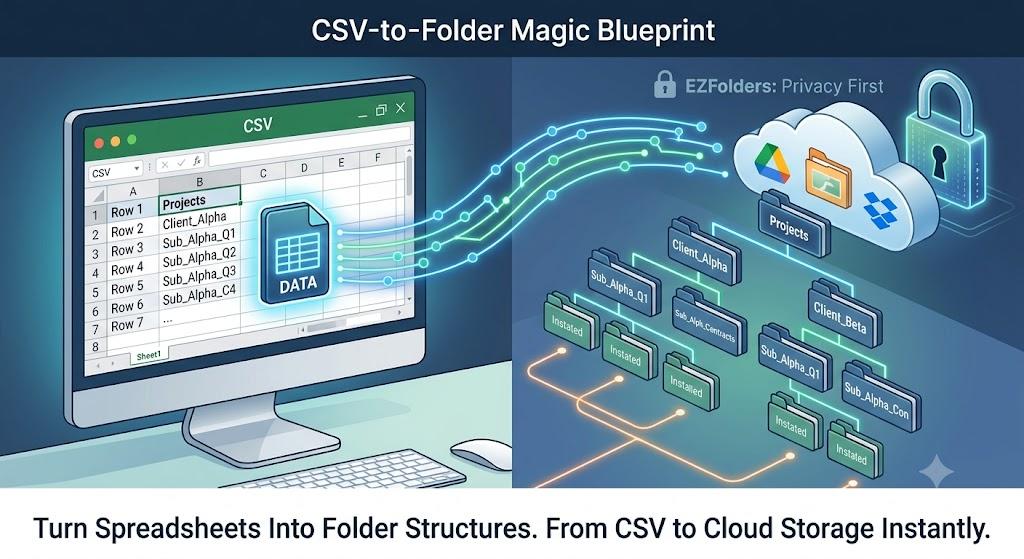
Many businesses think of automation as something highly technical, but one of the most practical approaches is often the simplest: using a spreadsheet. CSV-based folder setup allows teams to define parent folders and subfolders in a structured way before generating them in the cloud platform.
This is useful when folder hierarchies are detailed, multi-level, or repeated across a large number of workspaces. A CSV file can act as the blueprint, ensuring the same structure is applied consistently every time. It also makes it easier to review the planned hierarchy before anything is created.
Tools like EZFolders support this type of workflow by allowing users to build folder structures in Google Drive or Dropbox using either AI prompts or CSV uploads. For teams that want a no-code way to standardize setup, that can be a practical alternative to relying on scripts or repeated manual work.
Best Practices for Long Term Folder Organization
Automation works best when it supports a thoughtful structure. Before implementing any tool, teams should decide how files are actually used in their workflow. Folder names should be clear, intuitive, and easy to scan. Different departments should agree on conventions for naming clients, projects, dates, and file categories.
It is also worth avoiding unnecessary complexity. Deep folder nesting may look organized on paper, but it can make navigation slower in practice. A structure should be detailed enough to separate important categories while still being simple enough for people to use without friction.
Regular reviews are also important. As a business evolves, folder templates should evolve too. New services, new approval processes, or new reporting needs may require changes to the hierarchy. A system that is reviewed and improved periodically will stay useful much longer than one that is created once and forgotten.
In the end, the goal is not just cleaner storage. It is a more efficient way of working. And for teams managing recurring projects in Dropbox, adopting Dropbox folder automation can be one of the simplest ways to reduce admin work while keeping every workspace consistent and easier to manage.
Conclusion
Cloud storage works best when it is built around repeatable systems rather than one-off manual setup. As businesses create more projects, onboard more clients, and share more files across teams, folder organization becomes an operational issue rather than just an administrative one.
Using an online folder hierarchy creator, standardized templates, and automation tools can make cloud storage easier to manage, easier to scale, and easier for teams to navigate. Whether a business uses Google Drive, Dropbox, or both, the real advantage comes from creating a structure once and then reusing it consistently instead of rebuilding it from scratch every time.
FAQs
1. What is a folder hierarchy creator online?
A folder hierarchy creator online is a tool that helps users generate structured folder trees in cloud storage platforms without creating each folder manually. It is useful for repeated workflows such as client onboarding, project setup, and document management.
2. How does Dropbox folder automation help businesses?
Dropbox folder automation reduces manual work by automatically creating predefined folder structures for clients, projects, or internal workflows. This improves consistency, saves time, and reduces setup errors.
3. Is folder automation only useful for large companies?
No. Small businesses, agencies, freelancers, and startups can benefit too. Any team that repeats the same folder setup regularly can save time and stay more organized with automation.
4. Can I use CSV files to create folder structures in cloud storage?
Yes. CSV files can be used as a structured blueprint for creating multi-level folder hierarchies in platforms like Google Drive and Dropbox, especially when working with bulk or repeated folder setups.