English
 Arabic
 French
 Spanish
 Portuguese
 Deutsch
 Turkish
 Dutch
Dutch
 Italiano
 Russian
 Romaian
 Portuguese (Brazil)
 Greek
Greek
How Strategic Drivers Are Fueling Mesotherapy Market Growth
Health |
2026-07-14 12:19:05
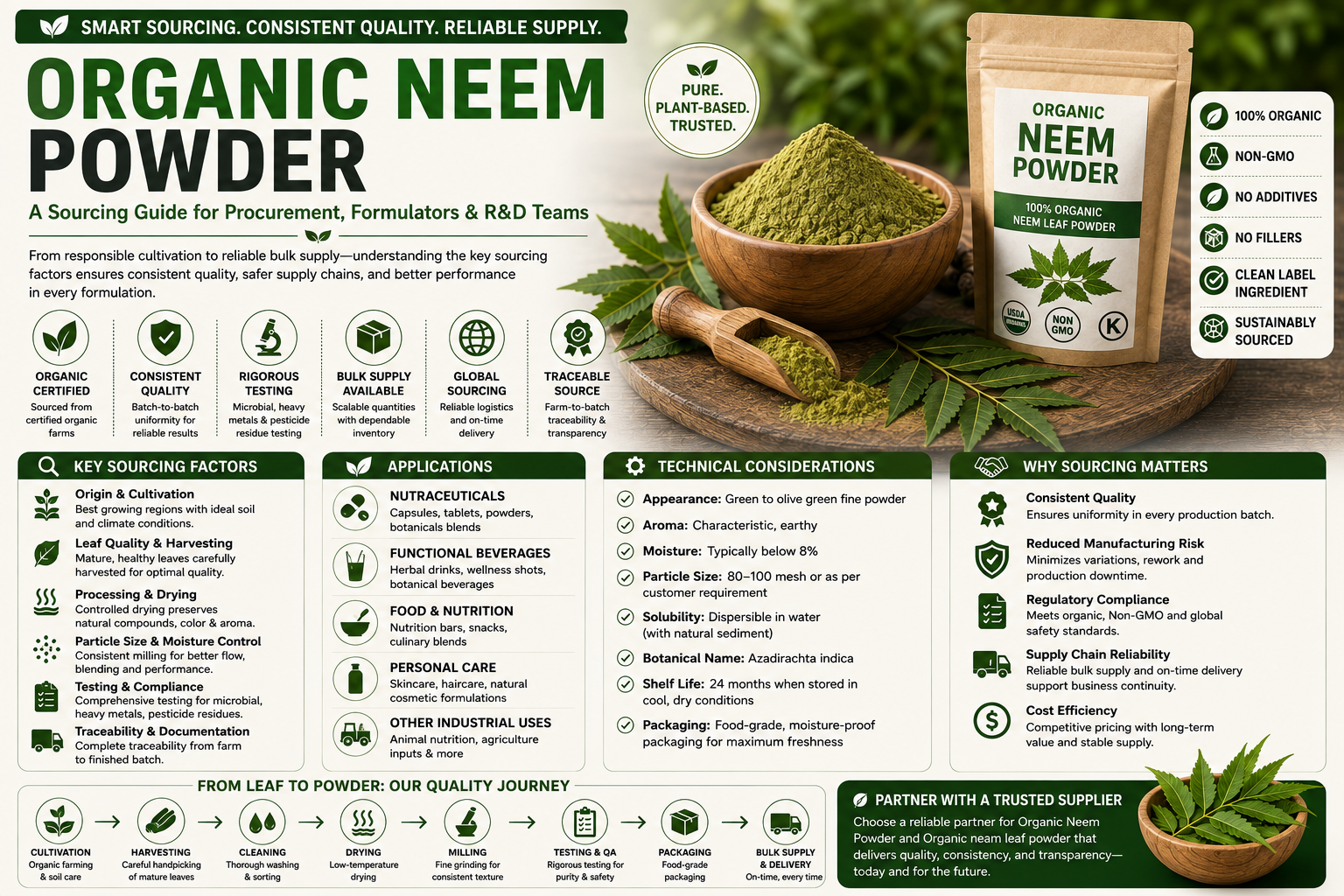
As the nutraceutical, food, and functional product markets in the US continue to grow, procuring teams are looking beyond price and general specifications when selecting botanical material suppliers. For botanical powders, the differences that arise from regional growing conditions, harvesting, drying, and milling practices can become apparent at the commercial production scale.
Organic Neem Powder is an example of such a botanical ingredient. Two batches of Neem Powder from different suppliers can have identical moisture, microbiological, and identity content, yet have marked differences in color, scent, and particle properties. With a few exceptions, these variations stem not from differences in specifications but from agricultural practices and processing.
Therefore, for procurement managers, formulation teams, and R&D specialists, the question is not which certified Neem Powder to choose, but rather which supplier can consistently deliver material of the same quality.
Overview: Understanding Organic Neem Powder
Organic Neem Powder comes from the leaves of the neem tree (Azadirachta indica). India is the leading producer of neem leaves, though the tree is also commonly found in other parts of Asia and tropical regions. Leaves are dried and milled into powder for industrial use. Depending on the conditions, leaf powder can vary in color, scent, and moisture content.
When buying Organic Neem Powder (which, in reality, is more often found as leaf powder), it is essential to understand that neem leaf, bark, seed, and extract are different materials with different specifications. Even though in some cases neem extract can serve as a substitute for neem leaf powder, the two materials are not interchangeable.
Qualifying Neem Powder Suppliers: Beyond Papers
When qualifying Neem Powder suppliers, the majority of companies make the critical error of focusing too heavily on specifications. Organic certification, Certificates of Analysis, microbiological and heavy-metal content, allergen information, and safety data sheets are all essential documents. However, even if the supplier has all the necessary papers in order, it does not necessarily guarantee that the product is suitable for a particular application.
Experienced procurement managers and R&D specialists pay close attention to the following details:
• Country of origin
• Botanical origin and plant part
• Harvest practices and drying procedures
• Moisture content
• Particle size and its distribution
• Visual appearance of different batches
• Packaging and storage conditions
• Traceability of the supply chain
In particular, for organic materials such as Organic Neem Powder, agricultural practices are of utmost importance, as organic certification requires extensive documentation and traceability along the supply chain.
Processing and Formulation Considerations
For R&D and formulation teams, Organic Neem Leaf Powder is a material with well-understood properties. Neem leaf powder is not typically used in concentrated or standardized form. Therefore, when considering Neem Leaf Powder for inclusion in a product formulation, R&D specialists can compare the powder’s characteristics from different suppliers. Such characteristics as powder flowability, particle size and distribution, moisture content, density, color, and scent should match the requirements for a particular application.
The characteristics of Neem Leaf Powder can impact the characteristics of the final product. For instance, a strong neem scent and taste can overpower other ingredients in a finished product. Therefore, it is always a good idea to conduct trials with the candidate material to see how it behaves in the intended formulation and affect the finished product’s characteristics.
However, if a formulation requires a concentrated source of neem constituents, it might make more sense to choose a standardized neem extract instead of leaf powder. Therefore, when choosing between leaf powder and standardized extract, the formulation itself should serve as a guide. The choice of the particular neem variant depends on the targeted composition of the final product.
Commercial-Scale Procurement: Challenges and Considerations
When moving from laboratory-scale experiments and trials to commercial production, the characteristics of a supplier’s material can change significantly. The reason for such changes can be seasonal weather conditions, agricultural practices, leaf maturity at the time of harvesting, and several other factors.
For neem leaf powder, such variations are often reflected in the changes in leaf color and scent. When ordering large batches of material, it is essential to establish what degree of variation is acceptable. In some cases, such variations do not impact the characteristics of the final product. However, considerable differences between different batches may suggest a lack of process consistency on the part of the supplier and should be investigated.
Before committing to large-volume orders, it may be a good idea to request samples of the proposed material and ask the supplier to conduct a series of tests:
• Botanical ID tests
• Pesticide residue screening
• Heavy-metal analysis
• Microbiological testing
• Organic certification audits
• Particle-size distribution
• Moisture-content determination
• Retention sample procedures
• Traceability documentation
Comparing the properties of different batches can be particularly informative. If the material varies significantly from one batch to another, it may be challenging to integrate the supplier into the long-term procurement plan.
Considerations for the Nutraceutical and Natural-Products Markets
When it comes to the nutraceutical and natural-products markets, the popularity of botanical ingredients is on a steady rise. Neem leaf powder is a material with well-understood properties that can be used in a variety of applications. It is typically utilized in botanical-based food products, nutraceuticals, cosmetics, and other finished goods.
When choosing between potential suppliers, formulation teams should consider specific characteristics of the ingredient. Strong neem scent and color, along with unique powder properties, might be undesirable or even unacceptable in some finished goods.
Conclusion
When sourcing Neem Powder for commercial production, it is essential to look beyond certifications and specifications. Close attention should be paid to botanical origin, agricultural practices, drying procedures, and material characteristics. Such aspects as particle size, moisture content, and testing procedures also play an essential role in determining the quality of Neem Powder and its consistency across different suppliers.
For R&D and procurement specialists, the best way to ensure the consistency of the purchased material is to review all documentation and request samples. Having seen the sample characteristics and tested the properties of the candidate material, specialists can determine the degree to which the characteristics of Neem Leaf Powder match their needs.
As formulation specialists develop new products and nutraceutical manufacturers seek ways to incorporate botanical ingredients into their products, attention to detail during the supplier selection process will allow them to obtain the most consistent material with minimal variations between batches.