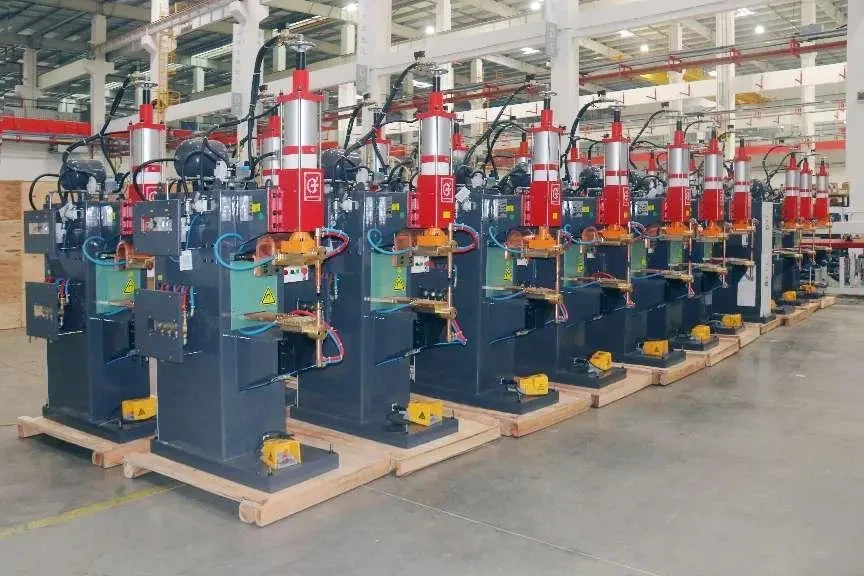
In modern metal manufacturing, a reliable spot welding machine is essential for producing strong, consistent, and repeatable joints. From automotive components and sheet metal assemblies to appliances and industrial products, manufacturers depend on controlled resistance welding to maintain quality while meeting production targets. Heron-Welder provides professional welding equipment designed to support demanding industrial applications, combining dependable performance with practical production requirements.
Why Spot Welding Matters in Modern Manufacturing
Resistance spot welding is widely used because it can join metal components efficiently without requiring additional filler materials. By applying controlled electrical current and pressure between electrodes, the process generates heat at the contact area and forms a localized weld.
For manufacturers working with high production volumes, this approach offers several valuable benefits:
- Fast and repeatable welding cycles
- Consistent joint formation
- Reduced material consumption
- Efficient sheet metal assembly
- Compatibility with automated production
- Reduced manual joining requirements
- Suitable for a wide range of industrial applications
A professionally configured spot welding machine can help manufacturers maintain production consistency while improving overall workflow efficiency. Heron-Welder focuses on resistance welding technology that addresses these priorities.
Understanding MFDC Spot Welding Technology
Medium-frequency direct current technology has become an important option for modern resistance welding applications. MFDC systems can provide controlled welding current and efficient energy delivery, making them suitable for demanding production environments.
Heron-Welder offers MFDC spot welding solutions designed for manufacturers seeking improved process control and repeatability. The technology can be particularly valuable in applications where stable welding conditions are essential for maintaining consistent product quality.
Compared with older conventional systems, modern MFDC technology can provide manufacturers with greater control over welding parameters and more efficient electrical performance. This makes it a valuable solution for businesses looking to modernize their welding operations.
Key Factors When Selecting Welding Equipment
Choosing the right welding equipment requires careful consideration of the production application. A machine that performs well for one component may not necessarily be the ideal solution for another.
Manufacturers should evaluate several important factors before selecting a spot welding machine.
Material Type
Different metals have different electrical and thermal characteristics. Material type and thickness should therefore be considered when determining suitable welding parameters and machine capacity.
Component Thickness
The thickness and number of material layers influence the amount of welding current and pressure required to create a reliable joint.
Production Volume
High-volume production requires equipment capable of handling repeated welding cycles while maintaining consistent performance.
Electrode Configuration
Electrode design, geometry, and accessibility can affect the welding process and should be matched to the component being produced.
Automation Requirements
Manufacturers planning to integrate welding into automated production lines should consider machine compatibility with robotic systems, tooling, sensors, and control systems.
Heron-Welder's broad resistance welding expertise helps manufacturers approach equipment selection according to their actual production requirements.
Improving Production Efficiency
Production efficiency is a major consideration for manufacturers operating in competitive markets. Slow or inconsistent welding processes can create bottlenecks, increase rework, and affect overall manufacturing costs.
A properly selected spot welding machine can help streamline repetitive joining operations. Automated or semi-automated welding processes can reduce manual handling while maintaining consistent welding conditions.
Heron-Welder designs welding solutions for industrial environments where productivity and repeatability are important. By combining suitable equipment with optimized welding parameters, manufacturers can establish a more efficient production workflow.
Supporting Automotive and Sheet Metal Applications
Spot welding is particularly important in automotive manufacturing, where large numbers of metal joints may be required across body structures and components. Consistent weld quality is essential for maintaining structural integrity and meeting demanding production requirements.
The same technology is valuable in appliances, electrical equipment, metal cabinets, and general sheet metal fabrication. These applications often require fast, repeatable joining without excessive heat affecting surrounding areas.
Heron-Welder's resistance welding equipment is developed to support these diverse industrial applications. Its solutions can help manufacturers address different material combinations, component configurations, and production volumes.
The Importance of Process Control
Machine performance alone does not determine welding quality. Effective process control is equally important.
Important parameters can include:
- Welding current
- Welding time
- Electrode pressure
- Electrode condition
- Material thickness
- Welding sequence
- Cooling performance
Maintaining stable parameters helps reduce process variation and supports repeatable weld quality. Regular equipment inspection and appropriate maintenance can further contribute to reliable production.
Heron-Welder emphasizes practical welding solutions that allow manufacturers to establish controlled and dependable resistance welding processes.
Why Choose Heron-Welder?
Heron-Welder specializes in resistance welding equipment and industrial welding solutions designed for modern manufacturing environments. Its product range supports applications including spot welding, projection welding, seam welding, automated welding, and specialized joining processes.
The company combines welding expertise with an understanding of industrial production requirements. This approach helps customers identify equipment that matches their materials, production volume, component design, and automation goals.
For manufacturers investing in a spot welding machine, selecting an experienced equipment provider can make a significant difference. The right machine can support production efficiency while helping maintain consistent welding performance over time.
Building a Reliable Welding Operation
As manufacturing continues to become more automated, reliable resistance welding equipment is increasingly important. Businesses need systems that can operate consistently, integrate with production lines, and adapt to changing manufacturing requirements.
A modern spot welding machine can serve as an important part of this strategy. With appropriate equipment selection, process control, and maintenance, manufacturers can improve production stability while reducing unnecessary manual work.
Heron-Welder provides professional welding technology for businesses seeking dependable industrial solutions. Its focus on resistance welding and automation makes it a strong partner for manufacturers aiming to improve their joining processes.
Conclusion
A high-quality spot welding machine can provide manufacturers with the speed, repeatability, and process control needed for efficient industrial production. From automotive structures to sheet metal assemblies, resistance welding remains a practical and effective joining technology.
Heron-Welder combines advanced welding technology with application-focused engineering to help manufacturers achieve dependable production results. By selecting equipment suited to specific materials, components, and production requirements, businesses can build a more efficient and consistent welding operation.
 English
 Arabic
 French
 Spanish
 Portuguese
 Deutsch
 Turkish
 Dutch
Dutch
 Italiano
 Russian
 Romaian
 Portuguese (Brazil)
 Greek
Greek