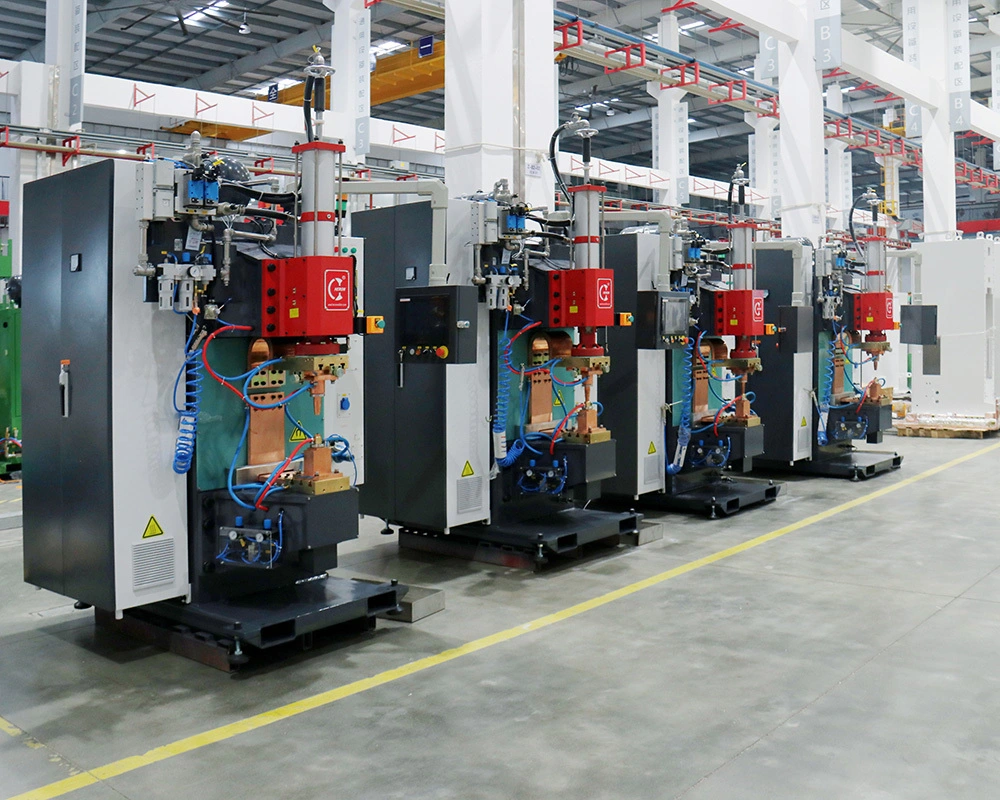
Modern manufacturers need reliable joining technology that can deliver strong, repeatable connections while supporting high production volumes. A professionally engineered projection nut welder provides an efficient resistance welding solution for attaching nuts to sheet metal and other suitable components. Heron-Welder offers advanced welding equipment designed to help manufacturers improve joining consistency, production efficiency, and process control across demanding industrial applications.
Understanding Projection Nut Welding
Projection welding uses specially formed projections on a workpiece or fastener to concentrate electrical current and welding pressure in specific areas. When the appropriate welding current and force are applied, localized heat forms the required connection.
A projection nut welder is specifically designed to weld nuts onto compatible metal components. The process can provide consistent attachment points while reducing the need for separate mechanical fastening operations.
Important benefits can include:
- Repeatable nut attachment
- Controlled welding parameters
- Fast production cycles
- Reduced need for additional fasteners
- Consistent joint positioning
- Suitability for automated production
- Efficient high-volume manufacturing
Heron-Welder specializes in resistance welding technology and develops solutions designed around the practical requirements of modern industrial production.
Why Projection Nut Welding Matters
Manufacturers producing brackets, panels, automotive components, enclosures, and other fabricated assemblies often require threaded attachment points. Projection welding can provide an efficient method for integrating nuts directly into metal components.
A projection nut welder applies controlled electrical energy and mechanical pressure to create a permanent connection between the nut and workpiece. This can simplify downstream assembly because the threaded attachment point is already incorporated into the component.
Heron-Welder provides professional resistance welding technology designed to help manufacturers establish stable and repeatable nut welding processes.
The correct equipment configuration depends on factors such as nut size, material type, sheet thickness, projection design, required welding force, and production volume.
Applications Across Industrial Manufacturing
Projection nut welding is widely used in industries where components require integrated threaded fastening points. Automotive manufacturing is a major application, while appliances, electrical equipment, furniture, and general metal fabrication can also benefit.
A projection nut welder can support applications involving:
- Automotive body components
- Metal brackets
- Sheet metal panels
- Electrical enclosures
- Appliance assemblies
- Industrial equipment
- Fabricated metal structures
- Component mounting points
Different materials and component designs require different welding parameters. Manufacturers should therefore evaluate the equipment according to their specific application and production requirements.
Heron-Welder's application-focused approach helps businesses select suitable resistance welding solutions for efficient and consistent nut attachment.
Improving Production Efficiency
Production efficiency is particularly important for manufacturers performing large numbers of nut welds. Manual fastening can require additional components, handling, and assembly operations.
A modern projection nut welder can automate or streamline the nut attachment process by integrating controlled pressure and electrical current into a repeatable welding cycle. This can help manufacturers reduce unnecessary assembly steps and improve production flow.
Heron-Welder develops industrial welding equipment with productivity and reliability in mind. Its solutions can help businesses establish efficient nut welding operations while maintaining consistent process parameters.
For high-volume manufacturing, equipment capable of maintaining reliable performance over repeated cycles can provide significant operational value.
Precision and Process Control
Successful projection welding depends on accurate control of welding force, current, time, electrode positioning, and component alignment. Variations in these parameters can influence the quality and consistency of the finished connection.
A professionally engineered projection nut welder provides controlled welding cycles designed to support repeatable nut attachment. Consistent process parameters can also help production teams establish clearer quality standards.
Heron-Welder emphasizes precision engineering and process control in its resistance welding technology. Its equipment is designed to support dependable performance in demanding industrial environments.
Proper tooling and electrode configuration are also important. Manufacturers should select equipment and tooling according to the nut design, material characteristics, and intended production process.
Supporting Automated Manufacturing
Automation plays an increasingly important role in modern production. Projection nut welding can be incorporated into automated manufacturing systems where repeatability, speed, and positioning accuracy are essential.
A projection nut welder can work alongside automated material handling, positioning equipment, and robotic systems to create a streamlined production process. Automated nut welding can help reduce manual variation while supporting consistent production cycles.
Heron-Welder provides advanced resistance welding technology designed for modern industrial applications. Its equipment can support manufacturers seeking to integrate efficient nut welding into automated or semi-automated production environments.
When developing an automated system, manufacturers should consider component positioning, nut feeding, fixture design, cycle time, welding capacity, and integration requirements.
Why Choose Heron-Welder?
Selecting industrial welding equipment requires careful evaluation of application and production needs. Manufacturers need reliable equipment that can maintain consistent performance while supporting their expected production volume.
Heron-Welder specializes in resistance welding technology and provides professionally engineered solutions for a variety of industrial applications. Its focus on practical engineering helps manufacturers choose equipment based on real production requirements.
Important considerations include:
- Nut and workpiece material
- Sheet thickness
- Nut dimensions
- Welding force
- Required production rate
- Electrode configuration
- Automation compatibility
- Equipment maintenance requirements
Heron-Welder's application-oriented approach makes it a strong choice for manufacturers seeking dependable projection welding technology.
Build a More Efficient Nut Welding Process
Reliable nut attachment can simplify assembly operations and improve manufacturing efficiency. By integrating threaded components directly into sheet metal assemblies, manufacturers can reduce certain downstream fastening requirements.
A professionally engineered projection nut welder can provide controlled and repeatable resistance welding for suitable nut attachment applications. When properly matched to the materials, components, and production requirements, it can contribute to efficient production and consistent finished assemblies.
Heron-Welder provides advanced resistance welding solutions designed around precision, reliability, and modern manufacturing requirements. Its expertise in industrial welding technology makes it a valuable partner for businesses seeking to improve nut welding processes.
For manufacturers ready to strengthen their production capabilities, Heron-Welder offers professional welding solutions focused on efficiency, repeatability, and dependable operation. Investing in suitable projection welding technology can help businesses streamline assembly, improve process control, and build a stronger foundation for long-term manufacturing success.
 English
 Arabic
 French
 Spanish
 Portuguese
 Deutsch
 Turkish
 Dutch
Dutch
 Italiano
 Russian
 Romaian
 Portuguese (Brazil)
 Greek
Greek