English
 Arabic
 French
 Spanish
 Portuguese
 Deutsch
 Turkish
 Dutch
Dutch
 Italiano
 Russian
 Romaian
 Portuguese (Brazil)
 Greek
Greek
Wound Care Billing Services in the USA: A Practical Guide to Faster Payments and Fewer Claim Denials
Health |
2026-07-09 08:29:12
Modern eye surgery requires a highly controlled, efficient, and technology-driven operating environment. A Modular Ophthalmic OT Turnkey Project Company can integrate advanced technologies across modular construction, HVAC, HEPA filtration, laminar airflow, environmental monitoring, medical gases, electrical systems, surgical equipment coordination, and digital controls. The objective is to create an ophthalmic operation theatre that supports precise procedures while maintaining appropriate environmental conditions, contamination control, workflow efficiency, and long-term reliability.
Unlike a conventional construction approach, a turnkey ophthalmic OT project brings multiple engineering disciplines together under a coordinated plan. Modern solutions can also incorporate smart monitoring, energy-efficient HVAC systems, advanced filtration, digital controls, antimicrobial and hygienic surfaces, and equipment-integration provisions. The exact technology selected should depend on the hospital's clinical requirements, room classification, surgical procedures, local regulations, and facility infrastructure.
Ophthalmic procedures often involve delicate surgical techniques and sophisticated equipment. The operating theatre therefore needs a carefully controlled environment.
Modern technologies can help address:
Technology should not be added simply because it is new. Each system should provide a measurable benefit and work effectively with the other components of the OT.
Modern modular construction uses factory-engineered panels and components to create controlled interior environments.
Common technologies include:
Modular construction can provide a more controlled installation process and allows utilities to be coordinated within the overall design.
The final specification may vary according to hospital requirements, budget, fire-safety requirements, cleanroom considerations, and maintenance expectations.
HVAC is one of the most important technologies in an ophthalmic OT.
Advanced systems can provide controlled:
Modern HVAC systems can incorporate variable-speed drives, digital controllers, sensors, and automated monitoring.
The system should be engineered according to the required operating conditions rather than simply selecting an air-conditioning system based on room size.
High-efficiency filtration is commonly used where controlled air cleanliness is required.
Modern systems can incorporate:
HEPA filtration should be integrated with the air-handling and distribution system.
Proper installation and subsequent integrity testing are important for verifying system performance.
Laminar airflow can be incorporated into ophthalmic OTs where the project specification requires controlled, low-turbulence airflow over a defined surgical area.
Potential benefits include:
The system may use HEPA-filtered air supplied through a ceiling-based or localized arrangement.
Its design should consider the surgical table, operating microscope, lights, equipment, personnel movement, and other potential airflow obstructions.
Modern OTs can use digital monitoring systems to continuously track environmental parameters.
Depending on project requirements, sensors may monitor:
Digital displays can provide staff with real-time information.
Advanced systems can also generate alarms when parameters move outside predetermined limits.
Smart controls can improve visibility and operational management.
Modern HVAC controls may include:
These systems allow facility teams to identify abnormal conditions more quickly.
Automation should be configured carefully so that safety-critical functions remain reliable and easily manageable by authorized personnel.
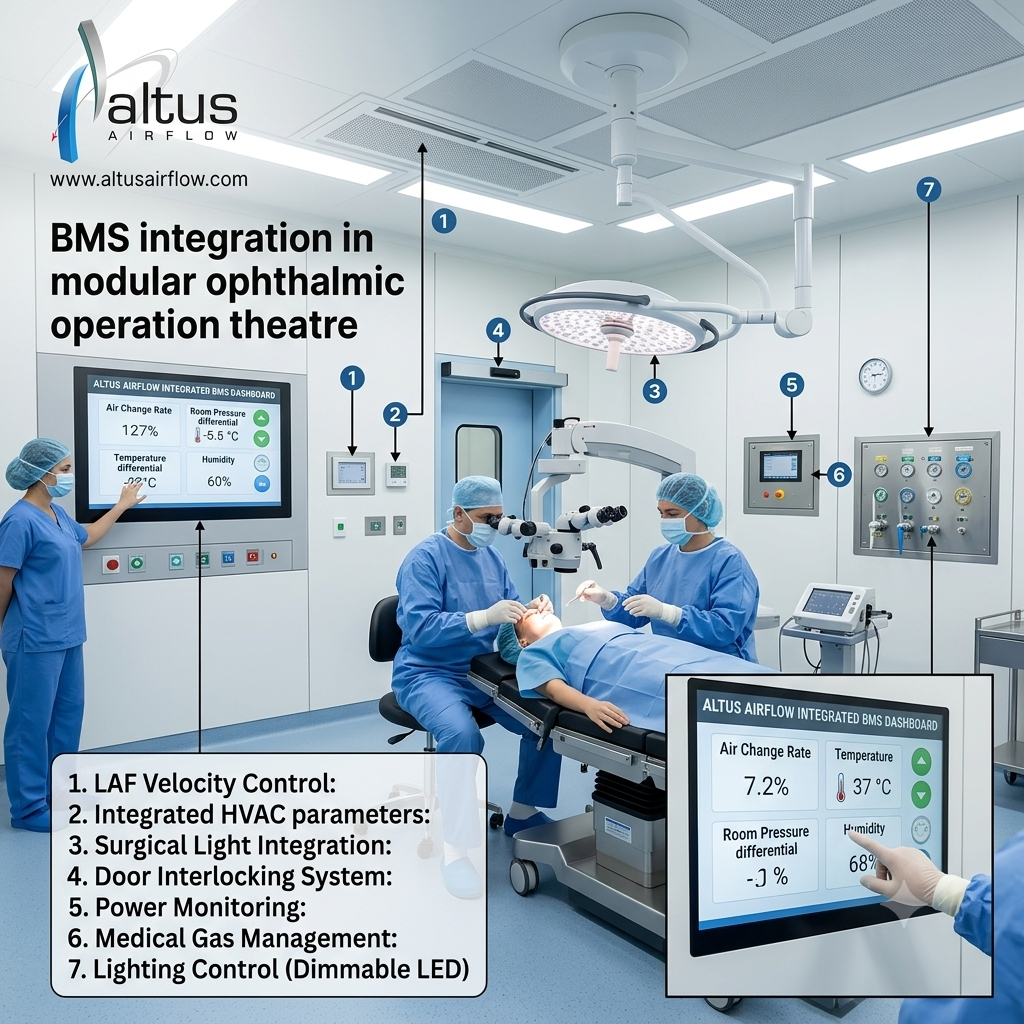
A sophisticated healthcare facility may integrate OT environmental systems into a Building Management System (BMS).
BMS integration can provide centralized visibility of:
This can help facility managers monitor multiple areas from a centralized interface.
The exact level of integration depends on the hospital's existing BMS infrastructure.
Airflow visualization can help engineers understand how air moves within the OT.
Smoke visualization or similar techniques can be used during testing to identify:
This technology is particularly useful when validating airflow performance around the surgical zone.
Air balancing is essential for achieving the intended airflow distribution.
Modern commissioning processes can use calibrated instruments to measure:
Balancing adjustments can then be made to bring the system within the specified operating range.
Pressure relationships can be important in controlled healthcare environments.
Digital pressure sensors can continuously monitor the difference between:
If pressure falls outside the configured range, an alarm can alert facility personnel.
This provides an additional layer of environmental control.
Modern ophthalmic OTs can incorporate advanced surgical lighting systems designed for precision procedures.
Features may include:
Lighting should be coordinated with the operating microscope and other equipment so that shadows and reflections are minimized.
The operating microscope is central to many ophthalmic procedures.
Modern OT planning can provide infrastructure for:
Integration should be considered during the architectural and engineering design stage rather than after construction.
Modern ophthalmic surgical tables can offer precise positioning.
The OT design should accommodate:
Equipment positioning must also be reviewed as part of the airflow strategy.
Equipment pendants and ceiling-mounted systems can help organize the operating environment.
They may accommodate:
Proper positioning can reduce floor-level cables and improve access around the surgical table.
A modern ophthalmic OT can incorporate centralized medical gas infrastructure where clinically required.
Potential services include:
Modern installations can include dedicated outlets, alarm systems, pipeline monitoring, and appropriate safety provisions.
The system should be designed and installed according to applicable medical-gas requirements.
Energy efficiency has become increasingly important for hospitals because HVAC systems can represent a significant portion of building energy consumption.
Potential technologies include:
Energy-saving strategies must not compromise the environmental conditions required for the OT.
LED technology is increasingly used for general OT lighting.
Benefits can include:
Lighting controls can also allow different illumination levels for different activities.
Modern modular OTs can incorporate surfaces designed for frequent cleaning and disinfection.
These may include:
The selected materials should be compatible with the hospital's approved cleaning and disinfection procedures.
Flooring systems can be designed to minimize joints and difficult-to-clean areas.
Possible options include:
Selection should consider:
Environmental alarm systems can provide early warning when critical parameters move outside specified ranges.
Possible alarms include:
Alarm thresholds should be established according to the project's technical specifications.
Remote monitoring technologies can allow authorized personnel to view selected OT parameters from another location.
This can support:
Remote monitoring should be implemented with appropriate cybersecurity and access-control measures.
Internet of Things (IoT) technology can connect environmental sensors and facility systems.
Potential applications include:
However, IoT systems should complement rather than replace essential safety controls.
Traditional maintenance often follows fixed schedules.
Predictive maintenance uses equipment data to identify potential problems before failure.
For example, monitoring:
can help maintenance teams identify changes in system performance.
This may reduce unexpected downtime when properly implemented.
Modern ophthalmic OTs require reliable electrical systems to support critical equipment.
Technologies can include:
Critical equipment should be connected according to the hospital's electrical safety design.
Power continuity is important for critical OT systems.
A modern project can coordinate:
The engineering team should identify essential loads and coordinate them with the hospital's emergency power architecture.
Turnkey projects increasingly use digital documentation systems.
Documentation may include:
Digital documentation can make future modifications and maintenance easier.
Advanced testing is essential for confirming OT performance.
Depending on project requirements, testing can include:
The results should be documented as part of the commissioning process.
The OT should be coordinated with the hospital's fire and life-safety systems.
Planning can include:
The design must comply with applicable local fire and building requirements.
A modern turnkey OT should consider future technology upgrades.
This can include spare capacity for:
Future-ready infrastructure can reduce disruption during later upgrades.
The greatest benefit comes when technologies are integrated rather than installed independently.
For example:
HVAC → HEPA filtration → Laminar airflow → Environmental sensors → Digital controls → BMS → Monitoring and maintenance
Similarly:
Modular construction → Equipment planning → Electrical integration → Medical gases → Surgical workflow → Validation
This integrated approach helps create a coordinated operating environment.
A technologically advanced OT can provide:
Technology should always be selected based on the hospital's actual clinical and engineering requirements.
Before selecting a turnkey provider, hospitals should ask:
These questions help hospitals distinguish a genuinely engineered solution from a basic construction package.
The latest ophthalmic OT technologies extend far beyond modular wall construction. Modern projects can incorporate high-efficiency HVAC, HEPA filtration, laminar airflow, digital environmental monitoring, smart HVAC controls, BMS integration, advanced surgical lighting, equipment booms, medical gas infrastructure, energy-efficient systems, remote monitoring, predictive maintenance, and advanced testing and validation. The right combination depends on the surgical procedures, hospital workflow, environmental requirements, available infrastructure, and applicable standards. A carefully integrated approach ensures that each technology supports the others rather than functioning as an isolated component. For hospitals planning advanced ophthalmic operating environments, Altus Airflow can provide specialized turnkey solutions that combine modular construction with coordinated engineering, environmental control, installation, testing, and commissioning.
A Modular Ophthalmic OT Turnkey Project Company may incorporate advanced HVAC systems, HEPA filtration, laminar airflow, digital environmental monitoring, smart controls, BMS integration, LED surgical lighting, equipment integration, medical gases, remote monitoring, and automated alarm systems.
Not necessarily. The requirement depends on the clinical application, design specifications, infection-control strategy, and applicable requirements. A Modular Ophthalmic OT Turnkey Project Company should determine the appropriate airflow solution based on the project's technical requirements.
HEPA filtration helps reduce airborne particulate contamination when properly selected, installed, and maintained. A Modular Ophthalmic OT Turnkey Project Company can integrate HEPA filtration with the HVAC and airflow-distribution system.
Yes. A Modular Ophthalmic OT Turnkey Project Company can integrate digital sensors for parameters such as temperature, humidity, pressure, and filter condition, with alarms or centralized monitoring where required.
BMS integration allows authorized facility personnel to monitor selected OT systems from a centralized platform. A Modular Ophthalmic OT Turnkey Project Company can coordinate OT controls with an existing hospital BMS where technically appropriate.
Read Our Previous Blog------>What standards and certifications are followed in Laminar Airflow System Setup Services?