English
 Arabic
 French
 Spanish
 Portuguese
 Deutsch
 Turkish
 Dutch
Dutch
 Italiano
 Russian
 Romaian
 Portuguese (Brazil)
 Greek
Greek
BM Digital Marketing Agency Dubai: Your Partner in Business Growth
Other |
2026-01-09 13:39:18
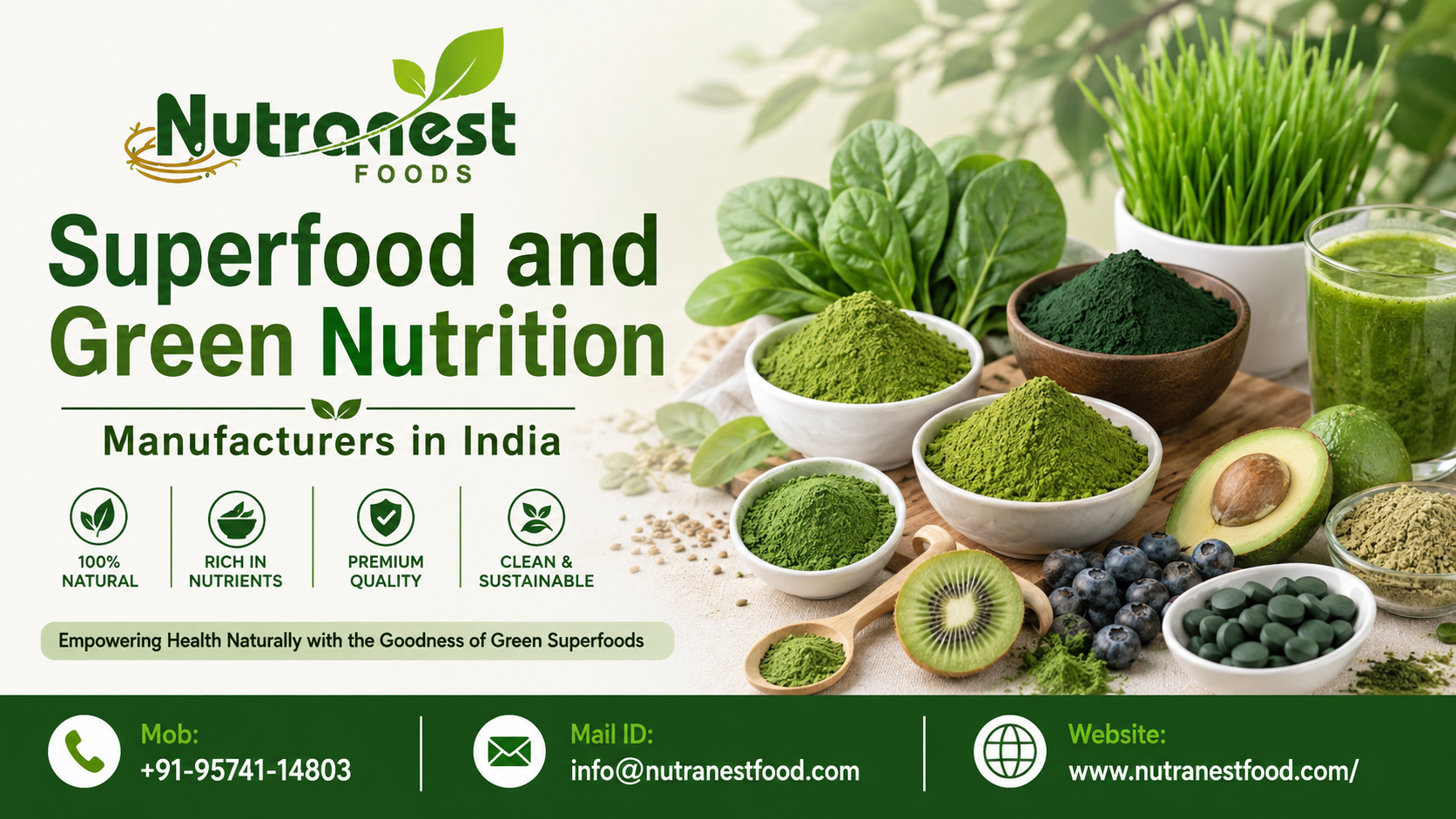
A wholesaler in Rotterdam once asked us for a 500 kg trial order of moringa powder, then followed up three weeks later asking why the colour of the second batch looked "off." It wasn't off. It was a different harvest cycle, and nobody had explained that to him upfront. That gap between what a buyer assumes and what a Superfood and Green Nutrition manufacturer actually controls is where most sourcing relationships go wrong. Get the specifications, the supplier vetting, and the logistics right, and green nutrition sourcing from India stops being a gamble.
Green nutrition covers a wider range than most first-time buyers expect: wheatgrass, barley grass, moringa, spirulina, chlorella, and blended "greens" powders formulated for capsules, smoothie mixes, or private-label sachets.
A 80-mesh moringa powder behaves completely differently in a cold-water smoothie mix than a 120-mesh grade. Buyers formulating for instant beverages need the finer mesh; buyers filling capsules can work with coarser material and save on processing cost. Most RFQs never mention mesh size at all.
Anything above 6% moisture in a leafy green powder is a mould risk within four months, especially in humid transit routes. This single number matters more to shelf life than almost any other spec on the sheet, and it's the one line buyers skip past fastest.
Lead, cadmium, and arsenic limits vary by destination market — the EU threshold isn't the US threshold, and neither matches India's own FSSAI limit. A supplier who tests against only one standard is testing for one market, not yours.
One detail buyers consistently overlook: chlorophyll content degrades with heat exposure during drying. A supplier using spray-drying versus low-temperature air-drying will hand you two products with the same label and very different nutrient profiles. Ask which method was used. Most quotations won't say unless you push.
Here's how to evaluate any manufacturer claiming to sell Superfood and Green Nutrition Manufacturers grade material and what a bad answer sounds like at each step.
Certificate of Analysis (CoA) per batch, not per product line. Bad answer: "We test periodically." That means your specific batch was never tested only some batch, at some point, was.
Traceability to farm or aggregator source. Bad answer: "We source from trusted farmers." Which farmers? Which state? A real answer names a district and a season.
Third-party lab reports, not in-house only. Bad answer: "Our internal QC is very strict." In-house QC protects the supplier's interests first. Third-party reports protect yours.
Willingness to share a defect and rejection policy in writing. Bad answer: “We’ll deal with it as we go.” A vendor claiming not to have a policy. That's a negotiation you'll lose after the shipment has already landed at your port.
Packaging suited to your shipping route, not their default. Bad answer: "We use standard packaging for everyone." Standard packaging for a domestic buyer and standard packaging for a six-week sea freight to Hamburg are not the same thing.
Buyers often frame supplier selection as a quality question. It's really a risk and margin question.
Fewer rejected shipments. Batch-level CoAs mean fewer surprises at customs or at your own incoming QC, which means fewer write-offs.
Predictable reorder cycles. A supplier who documents harvest seasons lets you plan inventory instead of reacting to shortages.
Lower compliance exposure. Correct heavy metal testing against your destination market's limits keeps your brand out of a recall notice.
Private-label flexibility. Manufacturers who already run capsule-grade and beverage-grade lines can adjust particle size and moisture specs without a full production changeover, saving you a re-tooling cost.
Better landed cost per kg. Moisture-stable powder loses less product weight to spoilage in transit, which changes your actual cost per usable kilogram — not just the quoted FOB price.
Fewer client-facing disputes. If you're a brand owner reselling under your own label, a documented spec sheet is what you hand your own customer when they ask questions. Without it, you're guessing on their behalf.
India's western belt — Gujarat and Maharashtra in particular — sits close to both the raw material growing regions and major export ports, which shortens the gap between harvest and processing. That matters for green nutrition specifically, because nutrient degradation starts the moment a leaf is cut.
Working out of Surat puts processing within a short haul of both agricultural sourcing zones in Gujarat and Mumbai's port infrastructure — a routing advantage that shaves days off the harvest-to-processing window compared to inland facilities further north. For wholesalers and brand owners searching for Superfood and Green Nutrition Manufacturers in India, that proximity translates into fresher raw material reaching the drying and milling stage, not just a shorter map distance.
One supply chain reality worth knowing: monsoon season (June to September) affects both harvest timing and container availability out of Gujarat ports. Buyers planning Q3 orders should factor in a slightly longer lead time during these months. We tell every new client this upfront, because finding out in week five of a delayed shipment is a worse conversation than finding out on day one.
We've been processing herbal and green nutrition powders out of Surat since 2013, and we still run our moisture testing before every dispatch — not because a certification body requires it, but because we watched one client lose an entire container to caking in transit early on, and we decided that wasn't happening again on our line.
We work directly with farmer aggregators across Gujarat and parts of Madhya Pradesh rather than buying through open-market traders, which means we can tell you which district your moringa or wheatgrass came from and roughly when it was harvested. That's not a marketing line. It's how we price and how we plan our drying schedules.
We switched from spray-drying to low-temperature air-drying for our chlorella line in 2019 after two buyers flagged that the nutrient panel didn't match expectations for a "raw" claim. It cost us throughput. We made the change anyway, because a mismatched panel becomes the buyer's problem at the point of sale, not ours.
If you're evaluating suppliers for Superfood and Green Nutrition, send us your target product (moringa, wheatgrass, spirulina, or a custom green blend), your destination market, and your required mesh size. We respond with a CoA-backed spec sheet and sample pricing within 2 business days. Minimum order quantity starts at 25 kg for trial batches and 250 kg for standard commercial orders. Email us at the address on nutranestfood.com or use the contact form mention "Green Nutrition Trial" so it routes directly to our export desk, not the general inbox. Nutranestfood
Sourcing Superfood and Green Nutrition products from India isn't complicated once you know which specs actually matter and which supplier answers should worry you. The buyers who get burned are usually the ones who accepted a vague policy instead of asking for the batch-level paperwork. The ones who don't, build supply chains that survive a bad monsoon season instead of getting derailed by one.
What's the difference between spray-dried and air-dried green powders?
Spray-drying uses higher heat and processes faster, which is fine for capsule-grade material where nutrient retention claims aren't critical. Air-drying at low temperature preserves more chlorophyll and enzyme activity but takes longer and costs more. If your label makes a "raw" or "cold-processed" claim, ask which method was used — some suppliers won't volunteer this unless asked directly.
Can Superfood and Green Nutrition Manufacturers customize mesh size for beverage mixes?
Yes, most established manufacturers can mill to a finer mesh for instant solubility, but it usually requires a minimum order above the standard trial quantity because re-calibrating the mill isn't worth doing for a small batch. Ask upfront rather than assuming your trial order will match your commercial-scale spec.
What certifications should I ask for before placing a bulk order?
FSSAI licensing is the baseline for anything processed in India. For export, ask for ISO 22000 or HACCP documentation, and get destination-specific heavy metal test reports rather than a generic certificate — EU and US limits differ enough to matter.
How do I know if a supplier's traceability claims are real?
Ask for the district or region name and rough harvest window for your specific batch, not a general sourcing statement. A supplier who can't name a location is likely buying through a trader rather than a direct aggregator network, which adds a layer you can't verify.
What's a realistic MOQ for a first-time buyer testing the market?
Reputable Superfood and Green Nutrition Manufacturers typically offer trial quantities between 20–50 kg specifically so new buyers can test formulation compatibility before committing to a container-load order. Be cautious of any supplier who insists on a large minimum for a first order that's a red flag, not a volume discount.
Does monsoon season actually affect delivery timelines from India?
Yes, and any supplier who tells you otherwise either hasn't shipped through it or isn't being upfront. June through September can add one to two weeks to lead times out of Gujarat ports due to both harvest scheduling and container availability. Plan Q3 orders with that buffer built in.